
 Music
Music
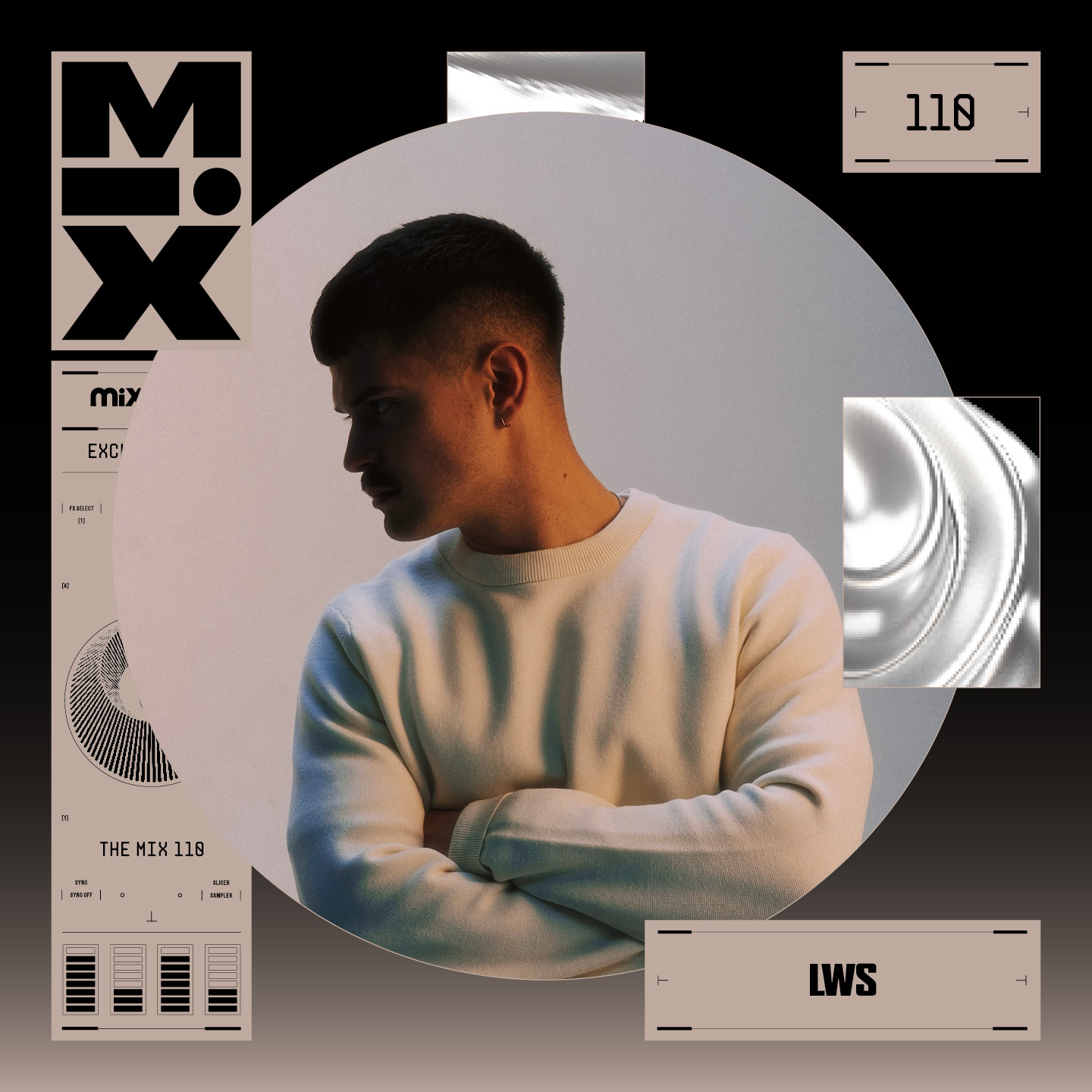
The Mix 110: LWS
The creator of some of the biggest dancefloor tracks of recent years shares a chaotically percussive mix that pushes into deeper grooves, and speaks to Christian Eede about "headfuck" music and not wanting to be pigeonholed as a producer
What is the sound of the summer? It’s a question that comes up around this time every year as festival season comes rolling into view. If you’ve attended any large-scale dance music event over the past couple of years, it’s hard to argue that Edinburgh-based Lewis Williamson, better known as LWS, knows a thing or two about the concept.
In 2024, ‘Steady On’ took summer festival stages by storm as it appeared in the sets of DJs such as Ben UFO and Pariah ahead of its release that autumn as part of the ‘Palloon’ EP on Call Super and Parris’ can you feel the sun label. Built around a screwface-inducing bassline, off-kilter percussion and a dizzying breakdown, it was peak-time club music at its chaotic, brilliant best. Last summer, it was the turn of ‘Many Request’, also eventually released via can you feel the sun in November, to do the damage from Dekmantel to Houghton. With whirring synths, driving drums and, naturally, another head-spinning breakdown, it garnered legions of track ID requests in the run-up to its release.
Williamson has also been establishing a connection with Verraco, Nyksan and DJ Lomalinda’s TraTraTrax imprint over the past two years. His 2024 tracks ‘Snips’ and ‘Gum Seleks’, with their rumbling sound design trickery, were highlights of the second and third instalment of the label’s ‘no pare, sigue sigue’ compilation series. “They first reached out in 2023 and so I started sharing music I was making with them,” Williamson says. “I wasn’t actively sending them demos because I felt like they were doing their own thing and I didn’t want to feel like I was intruding on that in some way.”
In February, ‘Gubbins’ dropped, marking his first full release for the label. Part of TraTraTrax’s expansion from its Latin American roots to building bridges with like-minded artists around the world, the zapping synths and propulsive percussion of its title-track are already destined to dominate festival sets all-summer-long. Williamson describes it as “probably the most club-ready thing I’ve put out”. Many people would be content to continue riding that wave, but not Williamson, who has been making music since he was 13. While no doubt buoyed by the success of his recent records, he’s keen to make time to explore new pastures as he looks ahead to what’s next.
Following the release of ‘Gubbins’ earlier this year, we spoke to Williamson below about the dancefloor moment that triggered his obsession with “headfuck” music, his desire not to be easily pigeonholed as a producer, and the DMs from Verraco that led to him putting out music with TraTraTrax. He’s also produced a wildly percussive mix that sees him push into deeper and ever groovier territory.

Can you talk me through how and when your music taste started to mature, and how you came across the underground dance music that influenced where you are now?
My best friend at school always had a keen ear for what was cool and he was watching a lot of Boiler Room streams. I think it was the summer of 2015 so I’d have been about 16 and Boiler Room put on a massive party in Edinburgh across four venues. Nina Kraviz was one of the people who played and I didn’t know who any of these people were at the time. My friend suggested that we go but it was an 18+ event, so we had to work around that. It started at 7:PM so we could still go to school the next day. We applied for tickets and got them. I don’t know what it’s called in England but in Scotland, you have a Young Scot [National Entitlement] Card and it’s something you use in school to put lunch money on it — it has other uses too. You could technically use it as ID so we put stickers over our year of birth on those and it worked.
Going to that event probably changed the whole trajectory of my life to this point. It was the first musical concert of any form that I’d been to. I hadn’t been to any gigs before that, so once I’d been to that party, the next two years were spent trying to get into places underage in Edinburgh. Eventually, I started going to a night called Headset at The Bongo Club, which is still going now and has a label, which I’ve released music on.
Going to Headset was very formative for me. It was quite a techno-focused party at that point, but you would also hear UK garage, UK funky and bits of dubstep here and there. The Headset party that I remember the most must have been in the summer of 2016. Skillis, who runs the night, was DJing in the main room and he played Pearson Sound’s ‘XLB’. It was the first time I’d heard it and it was crazy. It really stuck with me because it was the first time I was truly like, ‘What the fuck?’. It felt like the most crazy thing I’d ever heard, and from that point onwards when making music, I always wanted to try to recreate that feeling of weirdness. It’s probably what got me into trying to make headfuck music [laughs].
Did production come first for you before DJing then?
Yeah, I started making music about three years before I started learning to DJ. I was 13 and I was using a cracked copy of FruityLoops. I managed to get it working on the family computer that my mum bought in Aldi. I was cracking everything at the time, so I switched to Ableton not long after. I’ve been using that since then.
What kind of music were you making when you were 13?
It was inspired by cloud rap to an extent, because I was really into Yung Lean’s ‘Ginseng Strip 2002’. I also started off being into melodic EDM stuff like Deadmau5. It all changed a few years later when I went to that Boiler Room for the first time because it opened my ears up to another world of music. It was around the time Nina Kraviz started her label Trip. One of the first releases was Bjarki’s ‘I Wanna Go Bang’ and that was a massive gateway into techno for me, and then the label very quickly descended into putting out lots of weird IDM and broken techno, so it was very eye-opening and formative in the early days. That also tied into some UK techno stuff that I was into at the time to some extent.
How has the learning curve been for you in a DJing sense as someone who started out as a producer, and has built more of a profile from that discipline?
Starting to play for longer has been an exercise in pace and patience. When I was initially mostly just playing sets of an hour, I was stuck in the headspace of mixing out of a track every two minutes or so. You almost get an ADHD brain about it. Now that I’ve started to play some longer sets of up to four hours, I’m getting to hours three and four and feeling like I should be doing something at all times rather than letting a track breathe. It’s important sometimes to take a physical step back and let it chill.
This might sound like a strange question then, but now that your profile has raised somewhat as a DJ from your productions, do you consider yourself a producer who DJs, or are you trying to level the two disciplines in your mind?
I try to separate them as best as I can, though other people probably view me more as a producer. For example, I never really play any of my own tunes in my sets, and that’s quite a conscious decision. I’ve heard them enough anyway. It doesn’t interest me that much to play them. When I see a DJ who also produces music, I don’t necessarily want to hear the songs that they’ve made; I want to hear them present something else that is less predictable. It starts to feel like more of a performance than a DJ set if you’re overloading it with your own material. You should be taking music from all kinds of places. Some people can do it and that’s fine, but it’s just not what I’m interested in.
As a producer and a DJ, I also don’t like to be pigeonholed. Every time I do something with the sound of a particular record for example, I want the next project to move in a different direction. The last TraTraTrax record I did was probably the most club-ready thing I’ve put out, but now that’s out there, I want to go down a different path of making eight-minute-long tracks without kick drums, or something deeper, or whatever [laughs]. I find those tracks more rewarding to make in a way, because there can be such a thing as putting out too many big club tracks. It doesn’t pique my interest to make that over and over again.
Often, I’ll send out a pack of four tracks to DJs and one will be a mad banger while the other three will be deeper ones that I prefer. I’m always trying to push the latter ones but 90% of the time it’s the banger that gets the interest [laughs]. It makes me start hating on them a wee bit but I understand the appeal of course. Those kinds of tunes come to me really quickly when I’m making music, whereas I feel like I put more time and effort into the deeper and more technical ones, so maybe I care about them more and feel they’re a better representation of what I’m capable of.
It’s interesting that you say you spend less time working on the bangers, because often you would think it’s harder to make the music that has that big dancefloor impact.
I find that if you’re trying too hard, you will fail. It’s not something that you can force. I feel like I’ve just got lucky many times. They seem to be the tracks that the least conscious thought has gone into for me. I’ve zoned out for an hour and here I am.

Talk me through your production process. Is it particularly sample-heavy?
It’s not at all actually. I’ve been doing this for years but since the TraTraTrax release I’ve decided to zero in on it, so I like to take field recordings of me banging things wherever I am. I chop those sounds up to make percussion or other elements of tracks from it. If you loop very short samples, you can get weird and interesting-sounding chord progressions so that’s always really cool.
In the past couple of years, I’ve also got into modular stuff. Before I got into that, I used to spend too much time obsessively doom-scrolling the news, so now I spend that time researching modular synths on a website called Mod Wiggler instead. It’s fun, and I’ve now got to a point where I can realise more far-fetched ideas quite quickly. I used to do almost all of my production purely in Ableton and now more of it has been transported over to the modular stuff. A lot of these things have random buttons on them, so I often find myself just going crazy with them like I’m on a slot machine until something good comes out. I used some of it on the TraTraTrax EP, but some of those tracks were made before I really got into it, so I didn’t have as many machines as I do now at that point.
Do you remember where and when you first heard a big DJ of sorts playing your music out to give you that big ‘wow’ moment?
It was Ben UFO at Sub Club in 2022. He played one of my tunes for the first time on Rinse FM earlier that week and then he was playing in Glasgow that weekend, so I went to see him. All of my friends were there with me, and it was great. Later that summer, we were all at Dekmantel Selectors and GiGi FM was playing. You’ll recall that I was talking about field recordings, and on this occasion, I was on my way to the bathroom when I started hearing sounds from my washing machine in the background. I ran back to the stage because I realised she was playing one of my songs. That one never came out; it’s still just sitting on my hard drive.
I guess you’d just started sending early demos around to quite a few DJs by that point then?
I don’t want to use the term ‘mass emailing’ because that suggests I’m just giving it to anyone, but I sent some music out to about 50 people when I started to get serious about it during COVID. I did that for four years. I started knuckling down with seriously making tracks when I finished university and I decided not to get a full-time job at that point because COVID had just happened and I had an opportunity to focus on music.
Sending personal emails to different DJs with new tracks in them helped me to build a rapport with them. For example, with Joe [Call Super] and Dwayne [Parris], I’d been sending them tunes for maybe a couple of years before the first can you feel the sun record [‘Palloon EP’] came out in 2024. Their label wasn’t taking demos so I wasn’t doing it for the purpose of putting out a record with them specifically; that just happened from me sharing music with them to play in their sets.
How did that EP come about specifically? Did the tracks already exist in demo form when the idea came up of putting out a record on can you feel the sun?
I sent out a pack of four tunes in early 2024 for people’s DJ sets and then Joe [Call Super] reached out and asked if I wanted to do a release on the label. There are two tunes from that initial pack on the EP, and then the other two came about from them both feeding me ideas of the direction they thought the record should take. That was helpful because I feel like it made the final release a lot better and that has carried over since then. It was also quite difficult in some ways though, because some of the suggestions were more visionary than technical so you then have the challenge of realising those ideas. When I make tunes myself, I give myself feedback in a more technical, pragmatic way, whereas this was more mood-based so there are many different ways to interpret that.
‘Many Request’ from the more recent can you feel the sun record [‘All Of The Chaos’ EP] started off as a completely different track. They loved the breakdown but suggested that I change almost everything else. I ended up making four completely different versions of it with that breakdown in it to get to the finished track. I was really happy with where it ended up and it was way better than it would have been had I not done that.
How did the connection to TraTraTrax come about?
They messaged me on Instagram. I did the two-track release on Peder Mannerfelt Produktion [‘Pendrum / Now That’s Focus!’] in late 2022 and I think they started following my work from that record. They first reached out in 2023 and so I started sharing music I was making with them. I wasn’t actively sending them demos because I felt like they were doing their own thing and I didn’t want to feel like I was intruding on that in some way. I’ve never tried to replicate what they were originally doing on the label with the tracks I’ve made for or submitted to them because that’s not my lane. It just so happened that they felt that the kind of stuff I was already making could fit in alongside it. I wouldn’t want to encroach on that space. I’ve not even been to South America so it’s obviously not my place to do that.
The tracks that I contributed to the ‘no pare, sigue sigue’ compilation seemed to be very well-received. Occasionally, I’ll post Instagram Stories of tracks that I’m making where I’ll just wave my phone in front of the computer while it plays. JP [Verraco] watches them all, and he started sending me pen-to-paper emojis replying to some of the Stories [laughs]. A lot of ‘Gubbins’ came about from the tracks that had already jumped out to him from those short clips, and then I worked a little more on them with the feedback loop that we set up.
Can you tell us about your mix?
It’s a showcase of how I’ve been approaching club sets of late. I’ve been loving the chaotic energy of these really percussive, drum-focused tracks, and how that can be weaved through all different kinds of music to create something that sounds extremely natural and organic. Inside, there are older bits from my collection that I’ve rediscovered recently, unreleased bits from my good friends REGER and Kamus, and a little something that is brand new from myself.
'Gubbins' by LWS is out now
Christian Eede is News Editor at The Quietus and a freelance writer, follow him on Instagram
Tracklist:
1. Ricardo Villalobos & Samuel Rohrer - Malleus
2. REGER - Anesidora Dub
3. Skinnerbox - Gender
4. Tullio De Piscopo - Fastness (Lion's Drums Edit)
5. Enea Pascal - Si Ya Sabes Como Me Pongo
6. WaqWaq Kingdom - 3rd Eye
7. Quelza - Belly Jolie Movements
8. Tal Fussman - Rioz
9. Tropical Interface - Saturation
10. Mortar & Pestle - Pound Or Be Pounded
11. Kamus - ???
12. LWS - ???
13. Wata Igarashi - Esoteric
14. Sindh - Gataka
15. Sleeparchive - Ronan Point 2
16. Poima - Perelom
17. Suokas - Vir
18. Roma Zuckerman - Zero


