
 Music
Music
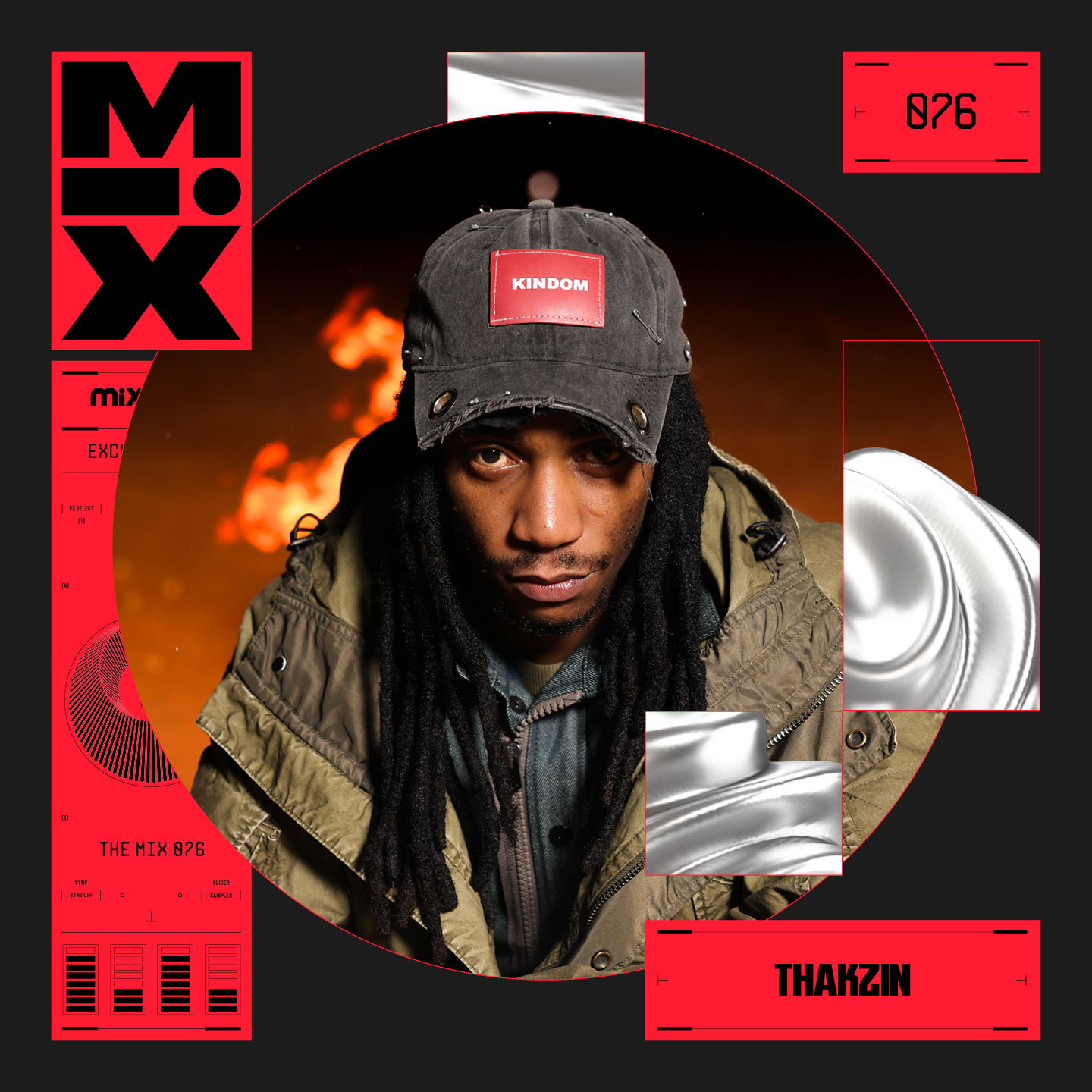
The Mix 076: Thakzin
Building on a rich musical legacy, Johannesburg innovator Thakzin shares a stirring mix and speaks to Jamaal Johnson about his spiritual upbringing, the rise of 3-Step, Europe’s relationship with African music, and his debut album ‘Gods Window Pt.1’
Raised in the suburbs of Johannesburg, Thakzin represents the latest in a long line of South African artists to have shaped dance music globally. Growing up on a diet of kwaito and deep house, as well as a variety of sounds picked up from his musical household including gospel, jazz and R&B, Thakzin is best known for his creation of South Africa’s hottest new sound, 3-Step. The experimental genre represents an evolution of the Afro house scene based around ‘tension and release’, identifiable through dropping a kick from the traditional house pattern of 4, hence the name. It came to worldwide prominence in 2023 garnering recognition from the likes of Kaytranada and Louie Vega, with a sound that adopts the melancholy and soulful harmonies of deep house, the guttural drums of gqom, and the crunching energy of amapiano; a blend which just feels so right.
Achieving this sound in an era where quick drops, trends, and TikTok-style ‘viral moments have taken over elements of the amapiano scene, his DJ sets are a breath of fresh air, harking back to simpler times through long, undulating blends, deft transitions, and an unbound rawness. With sets on Defected and Sondela Recordings, and releases such as his breakthrough hit ‘The Magnificent Dance’ racking up millions of streams globally, Thakzin is pushing forward African dance music by returning to its past, reaffirming the sense of spirituality and emotion.
Read this next: How kwaito opened the door for amapiano’s evolutions
Indeed he recognises that through his music he stands on the shoulders of giants, citing South African house icons such as Culoe De Song and DJ Kent as some of the musical figures who have shaped his journey. While Thakzin himself is often grouped in with amapiano DJs as part of South Africa’s ‘new-gen’ due to his evolution of the sound, he is well respected by older generations of the house scene, with his music moving back towards some of the tenets of Afro house that many feel are being lost. Thakzin embraces a sense of nostalgia, fighting back against the European commercialisation of African sounds, proudly telling me that he wants to bring the music “back to Africa.” — “And what is Africa?” he asks me ... “Rhythm.”
Thakzin achieves this sense of rhythm in part by channeling community spirit and collaboration as a very real aspect of his production process, with some of the songs on his forthcoming debut album ‘Gods Window Pt.1’ having as many as 10 co-creators, whom he tells me that (unlike some others) he is at pains to credit. He describes the collaborative way he makes music as a “state of mind to breach different sounds”. He sees himself not just as an artist, but as a vessel through which to receive a greater message, with this concept underpinning the fluid and experimental nature of the project.
This concept of spirituality is no gimmick — Thakzin’s family home in Jo’Burg suburbia was bordered on all sides by the sounds of Sangoma, traditional South African healing rituals designed to cure illness and cleanse the soul, achieved through the beating of drums and dancing to summon a spiritual awakening. Despite his occasional annoyance at the noise interrupting his studio sessions, Thakzin was taking it all in, and he now understands that without realising he was learning, with the rhythms of his youth playing a key part in the way he sees and makes music today.
It’s a muggy summer’s day in West London, a world apart from the formative settings of his adolescence that he so aptly recounts, as he sits down to tell me his story. Like his music, he is thoughtful and reserved at first, as he tells me about his discovery of amapiano, ‘Gods Window’, and his newfound relationship with London. Check it out alongside his mix below, showcasing the sounds of 3-Step, gqom and Afro house.

What were some of the earliest influences on your sound and your journey into music?
I was born into the kwaito era, that's the type of music I listened to growing up. My father also influenced me a lot with the variety of music he would listen to. At home, we'd have jazz, we'd have fusion, my sister liked R&B, and my mother was a gospel person, so there was a huge variety. Then, as I grew older, came the evolving of the sounds I like. That's where artists like Ralf Gum and DJ Christos came into it, and where I started falling in love with house music.
So was the plan always to do music?
No, but I would say it was always a part of my life. My father, without knowing it, was really shaping me to become a musical person because he was into so much different music, which was something he used to always share with me. He’d always be showing me new jazz artists, and I'd be like, “dude, I listen to kwaito though”. I learnt to love music from him.
Obviously you talk about a lot of it coming naturally because of your family, but I've read in your other interviews that the spirituality of music is very important to you. Could you share some of your beliefs around this?
I really believe that music is bigger than us. I believe that people who are able to make music, who connect with people in different worlds, have tapped into a certain spiritual level where they are able to receive the message. Not everything can be explained — a lot of musicians try to be very technical, but there are certain things, a human connection, and a feeling that you cannot always explain. You can listen to a song in another language, and you don't even know what it means, but you're sad, you've connected somehow. So I feel like there's a certain frequency where music is bigger than us and we are the receivers — we have to now paint it to the rest of the world. We are like the people that are able to tell the future … in Zulu we call this “Sangoma”.
I’ve read a little about Sangoma, and there's this idea of healing through percussion. Does that come into it as well?
Yeah, fortunately, I was able to experience very close encounters. At home, next door, there was a Sangoma [traditional healing]; opposite, there was a Sangoma. Behind the house, there was a Sangoma. They were all different natives, Sotho, Pedi, Tsonga … you'd see how they were working the spirit by beating the drums so that the spirit would shout. But for the spirit to come down, they needed to beat those drums, and then they would dance and dance and dance, and then it would quiet down. Somebody would undergo that process, they’d go through a spiritual awakening. But to be able to calm them down, you’d need to play the music.
OK, wow. What an amazing, formative experience.
I was experiencing that living next door, I was hearing those drums. For me at the time, I was like, “This is annoying, I want to record someone!” But it's that whole thing where I’ve now learned to appreciate those experiences. I wasn't aware that I was learning, but I was listening and taking it all in. My manager always says to me, “There was no way you were going to make jazz music. Where you come from with the noise and the drums, there's no way you could have made music that is so calm.”
Read this next: Journey Music: South Africa’s AfroTech sound travels globally and transports spiritually
So you talk about your township and the Sangoma rituals that have influenced you. In terms of artists and musicians, are there any people who have particularly influenced your sound?
Yeah, DJ Kent - I would listen to his mixes all the time. There was Black Coffee also, where I thought, okay, the sound is taking shape now, this guy is brave. He was doing something that wasn’t there before. I was also very much into Heavy-K, DJ Maphorisa, and DJ Loose. Culoe de Song was a game-changer for me, Da Capo also.
Then, out of all those influences, you created something new [3-Step]! Did you know that you were making a whole new sound, or was it just kind of something that happened?
I won't lie, it was something that kind of happened. The one thing that I always remember is coming from this gig where the people didn't feel it during my set, and I felt like I'd disconnected with my people.
Why was it that you felt disconnected?
Before amapiano took place, Afro house was at a certain level in South Africa, where you'd have Afro house DJs playing at peak hour. And then you got to a point where amapiano started to take over, and Afro house started to take a back seat. So, for me as a person who's coming from a different era, it kind of meant that my 11:PM slots now became 6:PM slots.
When you get there at 6, you're not getting the crowd that you want, and I’d be wanting people to listen, but I wasn’t getting that connection. So, I thought, let me stay until 11:PM. Let me stay until I understand. And I was like, whoa, these amapiano guys are on to something! I cannot lie - I was one of the late adopters, I was one of those ‘keep it real’, guys, ‘You people are ruining it’ guys. But I had my moment where I had to be humble in front of the sound and just listen to it for what it was.
While I had my moment, I still didn’t want to succumb to the norm, and that’s what I did with ‘The Magnificent Dance’. I thought, let me make a song where the bassline will make people dance, but the chords are a little bit different. So when you listen to the whole song, it's actually that structure where you have a bit of deep house with the chords, you have a bit of a rhythmic part to it, and then you have the bassline made from the log drum. It kind of worked out, and I decided to make an African EP with a different rhythm, as opposed to the whole 4/4. I tried to just have [he counts in time] “3 (pause) 123” and then see what I could do with the space. And for me, I wasn’t even thinking that it was going to change everything. I just thought that I couldn't do what I wanted to do if there's a kick all the time, I needed some breathing room. And then as soon as that happened, I was like, oh, now we're cooking.
The more songs I made, the more my friends started to say, “This is different, we need to be bold about it.” I don't even remember who decided, but they started saying, “Thakzin, we’re gonna call this 3-Step!”
That's amazing though, some of the best things happen just by accident! It seems maybe from the outside looking in that you wanted to make something for the people of your hometown … You talk a lot about African music, African sounds, is 3-Step almost about bringing it back to African roots?
Yeah. Because I kind of feel like there's a certain narrative, a certain way that we’re looking at making music where we’re adapting to the European sound and expectations. We’re making this music here in Africa, you know? There is this total disconnect there. This music needs to be something that feels like it is resonating with African people. And what is that? That is the rhythm.

Now South African music is almost leading the world in terms of dance music, and the log drum is being taken and used in so many different ways. How does this make you feel?
It tends to get deep for my African people. But for me, how I see it, I get so excited. Everything started somewhere, right? That's how we learn. For us to find ourselves, we need to adapt and learn from other people. So when people are adapting from us, it’s fair enough, don't you think? We were able to adapt sounds from other people, and then we did our African versions. Now the world is recognising us on a musical level, and they want to be a part of what we’re doing.
But people see it in a different way because it's very deep. There are traumas that we walk with; some people can't forgive. But for me, music is meant to be shared, and we share it across the world. Usually, we're used to sharing it in a communal space where it's your people, but now the rest of the world likes it. They want to hear it. Why not?
You have something very exciting on the horizon - your new album, your first full-length album. Firstly, just tell me a little bit about that. What can we expect?
It's a project that is meant to innovate, to be a breath of fresh air. Working on this, I really wanted to do it with my people, with everyone that got me here. It's not my album, it's our album. There are people who are singing these songs, and I'm like, this is our baby. It's titled ‘Gods Window’ [the name of a famous nature park viewpoint in Mpumalanga]. It’s also the view from the world above, from the spiritual level, the view where there’s no formula, there's no format, it's just feeling.
How does that feeling translate into the kind of physical and real production process behind the album?
Well, I couldn't do it alone. So for me to be able to spread that, I needed to combine souls; I needed to have people together. I needed the spirit of togetherness. And that's why we have so many people on it. There's one song that has 10 people in it. It's a combination of different vibes, different souls, it represents togetherness.
In amapiano there's a lot of that, and we need to take something from that because music is meant to be shared. You go through classical songs, and there are so many artists in the credits. But it's just that maybe it was never meant for people to know. But for us, if we have a guitarist there, we wanna give them the chance to shine. We want to feature the guitarist.
So many producers don't do that.
It's that inclusion where we do music together and this is what it means. I want to make it normal because it should be normal. That's how you avoid people feeling exploited. That's the story of a lot of artists that I know, where I come from. If you have a chance to make someone shine on a track, make them shine because that is their shine as much as it is yours. If someone played something there, they played it! You didn't play it.
Those are the stories that people go through, sadly. My view on it is like what Dr Dre said - “I used to be a starving artist, so I'd never starve an artist”.
Read this next: Amapiano’s Second Wave: Upcoming producers and the risks of exploitation
So I've already been lucky enough to hear ‘Bozza Mthathe’. I haven't heard a drum pattern like that, it's a bit like 3-Step, but then that third kick is syncopated on the offbeat. Is that song kind of a marker for the whole album, a new direction for you … how would you place it?
Trust me, don't think you're going to hear another ‘Bozza Mthathe’ on that album. It's a unique song. Every song has a life of its own, and every song is tapping into a certain sound. ‘Bozza Mthathe’ is more or less tapping into that dark and also that gqom vibe, and it's also 3-Step. Though, is it 3-Step really? It's a state of mind.
Is there one song you're particularly excited for the people to hear, and what is the meaning behind it?
There's a song called ‘When We Play’. It sounds exactly like that, people playing, a guitarist playing. The feeling it brings is so grounding. I can say so much about every song that you might mention, but that song definitely reflects how I’m feeling in this moment.
Good, I’m excited to hear the rest of it! While you’re here, I wanted to ask you how you connect with the London listeners? Are there any differences you notice? Talk to me.
This place is amazing, man. I've never had a bad crowd in London. It's where I feel like I'm heard, where this thing is heard. And you look at it, it's very diverse. The people who come to shows are all different races, different backgrounds, different ethnicities. With what my music represents, seeing them dance, I always feel a certain connection when they get it.
I'm approaching London in a different way now. I'm doing studio. I'm capturing the atmosphere, I'm hearing the train, the noise, the tube, I'm hearing the sounds of the streets, different sounds to what I hear at home in South Africa.
And finally, tell us a bit about the mix you’ve recorded for Mixmag?
Every mix is a journey, and this one holds something special. With tracks from the upcoming album woven through, it reflects what 'Gods Window Pt. 1' means: unity, togetherness, and the timeless power of music to connect us all.
'Gods Window Pt.1' by Thakzin is out this Friday, September 26, pre-order it here
Jamaal Johnson is a freelance writer, follow him on Instagram
Tracklist:
Thakzin, Jinger Stone - Ke Nna Yo
Thakzin, Mzizi, Jordan Moozy - Need Your Love
Thakzin, Atmos Blaq & Mpho.Wav - Imali Yephepha (feat. Suffocate SA, Citizen Deep, Divine Keys, Baby S.O.N, TETÉ)
Thakzin, Baby S.O.N - Jabula
Thakzin, Mhaw Keys - One Light Many Hands
Thakzin, Mörda, Xelimpilo - Utlwa
Thakzin, Mzizi - Moya
Arabic Piano x Innovator - Uze Nenye
Thakzin, Mankosabe Cultural Group - Botho Begins With Her
Oskido Feat. Candy - TSA Mandebele (AtmosWav Remix)
Dlala Thukzin, Goldmax, Funky Qla - Washa


