
 Features
Superstar DJ, here we go: Marlon Hoffstadt is locking in
Born and raised in Berlin, Marlon Hoffstadt fell for the city’s underground club culture as a teen — though it never loved him back. Now a global dance phenomenon, the journey hasn’t been a smooth one. Recently sober, signed to a major, working with popstars and sounds previously confined to the charts, while still playing the odd basement club, he’s a defining DJ of the now, and he’s not afraid to admit the reasons why. Paul Hanford hears him out
Two Trick Pony is a popular anglo-themed bruncherie in the more sedate quarter of Berlin’s Kreuzberg district, the kind of place where even in freezing winter people are happy to queue outside to grab a table. On this particularly chilly morning, its minimal aesthetic hums with chatter and eggs benedict: a low-key meeting place to spend a couple of hours with one of the city’s least typical, and most colourful exports.
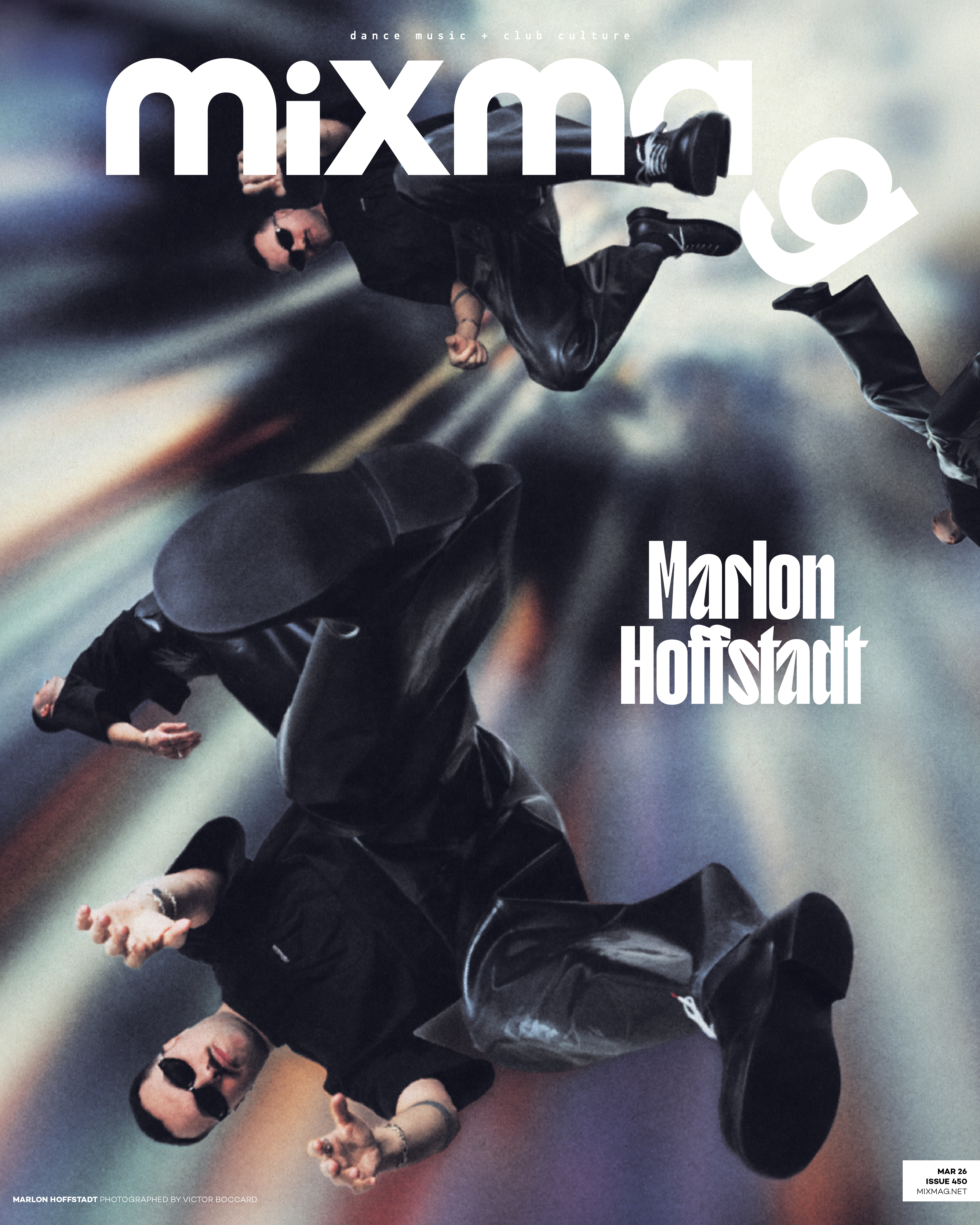
Marlon Hoffstadt blends into this environment more than any of his hands-in-the-air viral moments might suggest. His tall frame, moustache, baseball cap, black T-shirt and a few pieces of jewellery fit the muted Berlin colour-palette. His hair today is his natural brown, unlike the cropped bright pinks, greens, blondes and oranges that helped synergise Marlon and his DJ Daddy Trance alias in a relatively short space of time from local underdog into global brand.
“I was standing there having goosebumps,” Marlon says, looking back on a pivotal moment last May. He is talking about how he staved off playing the US until he could, in his words, arrive with a bang. That bang came playing in front of 70,000 people at the Electric Daisy Carnival in Las Vegas last May. Sandwiched on the world’s largest dance stage between arena monoliths Tiësto and Armin van Buuren. “I never really do this more commercial stuff, like, [tell the crowd] ‘pull your phones with a flashlight out’,” he tells me, as conversation turns to a huge outdoor three-hour set at the Sidney Myer Music Bowl in Melbourne in December, “but I did it there. I could have started crying.”
Read this next: The Cover Mix: Marlon Hoffstadt AKA DJ Daddy Trance
That admission might seem strange coming from someone whose ascent is characterised by big, brash and what some might see as overtly commercial moments, be it the punky-trashy-sugar rush of turbo-fuelled anthems like ‘It’s That Time’ and ‘Supersonic’; an optimisation of behind-the-scenes fan-satiating social media, or a propensity to get on the mic during sets. The sets themselves, like EDC or last year’s final cherry-on-the-cake in Melbourne position Marlon as superstar DJ, teasing and then rewarding crowds with pumped-up Y2K anthems.
In person, Marlon comes across as both genuinely sweet, unusually frank and refreshingly pragmatic in how he talks strategy – perhaps a cue developed through studying a degree in PR and journalism. “Last year was very big for me,” he says. 2025 saw him signing with Capitol Records and collaborating with major pop acts like Robyn and Mark Ronson. “But on the other side there was not as much growth between me and the fans as there was in the years before, because it wasn't new anymore, it wasn't surprising anymore, and it kind of freaked me out for a moment.”

Our scrambled eggs arrive, Marlon places his phone next to his plate and says: “Just in case the Kindergarten calls.” Fatherhood looms large. Stepping into the DJ Daddy Trance alias came at a point where he was close to quitting, developed out of nicknames his friends, particularly fellow DJ and Club Heart Broken founder MALUGI gave him: “I was a dad, I played trance.” Simple, yet also deliberately vague, he says. “It could take multiple directions. It could be sexual, it could be literal.” He references Sven Väth, who named himself Der Papa, because, says Marlon, “he's basically the German dad of techno.”
Then there are the non-negotiables that come with fatherhood – childcare means he only plays every second week, recording hours take place between runs to the kindergarten, but there’s a deeper rooted level to it too. “After my child was born, shortly before I finished my bachelor’s, I had a breakdown,” he tells me. “I was in a day clinic, and then after this I continued another year of therapy, I started doing antidepressants. And to be honest, at some point I had this attitude: I really don't give a fuck if anyone likes what I do, I just do what I like.”
Although the DJ Daddy Trance moniker had been bubbling into viral-dom since 2022’s ‘Day 'n' Night’ (a cover of the 2008 blog house remix of Kid Cudi by Crookers), it was really 2023’s ‘It’s That Time’ that cemented Marlon’s place on the big stage: trance-inspired and a punky vocal sample, it captured that moment post COVID-19 when crowds wanted to shrug off seriousness in favour of hard and fast fun. This has made Marlon somewhat a divisive figure, labeled Gen Z Trance by detractors, or as his manager, Bastian, puts it: “People either love or hate him. There’s no middle ground.”
“I can't change what people think,“ Marlon says. “I just want to make sure that I like it, because [beforehand] I always did music for people to like my sound, maybe even to like me, but it never worked, because I also didn't like it myself.”
There is a lot of history before we get to DJ Daddy Trance. In 2014, while still a teenager, the tech-house leaning ‘Shake That’, co-produced with Dansson, got picked up by Pete Tong’s FFRR label a year after it had been independently released. “It went into the charts for a moment but I was never really feeling the sound too much to follow up on a commercial level.” That exposure at a young age thrust him into playing every weekend, travelling without a tour manager and often on his own. “No one was really checking in if this might be too much for me,” he says. “I had moments where I would just feel so overwhelmed, just 18 and 19 years old, in the hotel room, crying, calling my parents.”
At heart, Marlon is as Berlin as they come, tapping into the city’s clublife since the age of 15. “My girlfriend back then, her parents would often be away on the weekends, and her bigger sister would look after us, which she didn't, and we just went out with her friends,” he says. This was an entry point for the under-age Marlon into a now near-mythical era in the city’s clubbing history, those last few years before Berlin’s popularity over-reached into full-blown gentrification. Weekends would be spent in Kater Holzig (the precursor to Kater Blau), Maria, Magdalena: “all these older venues that don't exist anymore.” A huge influence toward becoming a DJ came from watching Paul Kalkbrenner’s 2008 era-capturing film, Berlin Calling. “It was mind-blowing,” he recalls thinking. “I want to be this guy on drugs in Bar 25.”
Berlin is a city where the excesses that come with the potential of partying 72-hours straight are normalised to the point of meme-fuelled affection, something that the young Marlon embraced, but there is a darkness to the city that anyone who has spent time here will be familiar with. “A lot of people get lost here in Berlin,” he says. “and I got lost as well.” Marlon has been drug-free for around a decade. “It was more a physical thing, why I stopped, I just was sick all the time, you have these highs and lows.” He’s now a year off alcohol too. “I was never really a heavy drinker,” he says, while confessing to a certain fondness for the ritual aspect of hammering his ring on the metal cap of Clase Azul Tequila, and how he could drink half a bottle without it affecting his skills on the decks. “But the last two years were tough.” He describes January 2025, at the end of touring Australia, as a wake-up call. “My behaviour scared me,” he says. “My mindset, my general well-being scared me. I felt, okay, I could start hurting people because I’m not the master of my doing.”
Sobriety hasn’t insulated him from pressure. “I had a situation in a club where a DJ wanted to drink shots with me,” he says. “And this person didn’t want to accept that I don’t want to drink.” Eventually, a booking agent intervened, quietly filling the shot glasses with water.

The years between early success and DJ Daddy Trance were marked by trying — and failing — to fit into Berlin’s underground flow. “I went to all these cool clubs, Berghain, OHM, Griessmühle,” he says. “And I noticed, okay, this is actually what I want to do. But I never really managed to make that sound. I tried to be underground, but for the underground I was way too commercial and not cool enough.”
During these years, that outsider quality could well have been the catalyst for connecting him up with the aforementioned Cologne-hailing MALUGI, whose Club Heart Broken collective, series and eventual label Marlon became (and still is) a part of. CHB’s tagline “A safe haven for lovers, loners and losers” and deliberate rejection of the austere techno seriousness of the scene in favour of an “all feelings are allowed” attitude could easily be read as an emotional enabler that would lead to the unashamed joy of his current sound.
Despite that “fuck it” moment of deciding to just pursue what he likes, that love of trance you can hear running through his resurgence gestated further back. “If you go through the catalogue,” he says, “you see the journey, it got faster slowly, it got more atmospheric, more trancey.” He points to ‘Planet Love’. Released pre-DJ Daddy Trance, he pressed 500 double-vinyl copies with full artwork. COVID hit just before release. “I was in debt,” he says. “Minus €5,000. And I released it anyway and all of a sudden I started to feel like something was happening.” Six years old now and a curio piece when compared to, say, the 70 million Spotify streams for ‘It’s That Time’ or high-profile remixes for artists like Madonna and Calvin Harris. However, I can hear ‘Planet Love’ serving as a bridging gap between the Marlon of then and of now: there is an almost kosmische utopian-feel to its arpeggiators and '90s synth stabs. You can hear something forming – like a baby DJ Daddy Trance birthing himself into being.
“What I don’t like about old-school trance is the cheesiness, at some point how these cheap vocals got in there,” he says. “But what I love is the drumming. The balance of bassline, kick and drums.”
Through the two hours we spent talking, Marlon is refreshingly outspoken. Comments that might read on paper as provocatively frank come across, in person, as being humble and just plain principled. In a landscape where too many big names remain silent, happy to take payola over moral considerations, he confesses: “I have quite a big list of promoters I don't work with anymore.”
“I get so many bookings where there's not one single woman on the line-up,” he says, as a principle he actively refuses and even pulls out of male-only lineups. “I am not playing a stage where you don't book a woman, at least one woman, I'm not even asking for 50/50. And then promoters always try to trick you, like, ‘yeah we have a woman on the line-up on floor number 3.’ I don't want a warm-up slot, I want a proper headliner slot because there are so many female headliners.” Yet while saying this, there is a touch of self-awareness to his words, that in talking about it there’s the possibility of taking credit for what should be the selfless role of allyship: “I don't want to say ‘I'm the saviour’ or some bullshit like this because it's not even close to what should be done. I don't need applause for me doing it.”
If 2025 was outwardly massive yet a period where, for him, the growth slowed, 2026 could be a year where the boundaries between DJ and popstar diminish further. His popularity seems to encapsulate a point where the dividing lines between what is ‘underground’ and what is mainstream feel more blurry than they once, at least on the surface, did. Marlon can go from a 70,000 capacity stage at Electric Daisy Carnival to somewhere tiny like Glasgow’s Sub Club or London’s “100% DIY” venue The Cause with Club Heart Broken and it doesn’t raise much of an eyebrow. This summer, Skrillex will play Dekmantel and Ben UFO will play Tomorrowland. Examples of lines being straddled that felt uncrossable a decade ago can be seen across electronic music.
“I'm entering a very commercial world,” Marlon says, “but I'm still very much interested in not losing this ethos that I learned here in Berlin.” He’s symbolic of this moment, where those are no longer incongruous concepts. What’s rarer is his honesty about it. “I think many DJs that consider themselves or frame themselves as underground artists are not underground, because if you're touring internationally, playing clubs with high entrances and sharing stages on big festivals, it's not underground,” he says, reflecting on the at-times aesthetic nature of the categorisation. I think of a beat from a piece by the legendary music writer Simon Reynolds from 2011 (recently repackaged in his Futuromania anthology) where he pontificates that in electronic music, the underground has become replaced by the boutique. Small and fashionable, but not necessarily anything more than a set of tropes. There are genre touch points that, when they’re hit, give off an aura of underground authenticity, just like minimalist Scandinavian furniture gives off a certain aura of authenticity in a third wave coffee shop.
To Marlon, the true definition lies outside of sonics: “I think it's more about the work you contribute to the local scene, to an underground scene, to the decisions you make and the spaces you create.” Therein lies the ethos he hopes to retain, incorporating wider scope of values nurtured through small parties, DIY culture, queer and marginalised communities. Fortunately for Marlon, the sounds he’s drawn to have become more accepted in those spaces too, with the rise of BPMs, fluoro-happy melodies and tracks that reject long, building groove for short sugar-rush Top 40 momentum.
“Life in general for everyone started to be a lot tougher around COVID-19 than it was before,” he says, pinpointing when this change started to take place. “And I feel that music that is harder, faster, louder, more energetic can be a tool to express or release feelings.” Marlon’s ascendence (more or less) corresponded with the re-opening of nightlife, and with that, the emergence of a new generation of ravers unschooled in the social blueprints laid down by their slightly older nightlife peers. TikTok and Reels helped normalise subcultural styles as trends. This is not in any way to suggest Marlon’s bright hair colours and even brighter sound is in anything less than a genuinely authentic expression of an artist who arrived at a point, said ‘fuck it’, and found a way to express himself sincerely, just that the timing of this re-emergence hit this particular epoch bang on.

For 2026, there are big shows lined up: Coachella, Ultra Miami. Upcoming singles ‘Breathe’ and ‘Water’ double down on the euphoric. He’s been involved in songwriting camps. Signing to a big California-based label such as Capitol, he says, isn’t about becoming pop at the expense of everything else. “I want to do pop stuff, I want to do techno stuff,” he says. “I don’t really want to limit myself. I’ll always take that chance.” That blurring extends into the name: now billed on posters as Marlon Hoffstadt aka DJ Daddy Trance.
Outside of the shorter, mic-wielding headline sets packed with originals, he still has time for back-to-backs with artists like KI/KI and VTSS, which he says, are different — “proper DJing”, more preparation, more other people’s music.
Underneath it all however, there is still the guy who started off clubbing at 15 in Berlin, he may not follow the city’s club blueprint, but this city is a place whose culture he still feels a connection to. “There still is quite some interesting club culture here,” he says, “but it’s shrinking. These smaller communities aren’t getting funded. They’re closing down.” He’s critical too of a certain institution. “Obviously nowadays the focus is so much on Berghain, which has a purpose and there's a reason for it. But I think it's not a place of innovation, in my opinion,” he says. “I'm also not the biggest part of innovation in Berlin, that also needs to be said. But a lot of innovation comes from smaller communities who do really, really cool parties.”
As brunch wraps up, Marlon gathers his things, phone still within reach. I feel cheeky and ask for a photo, he reacts warmly and says “of course.” I aim my phone and he raises his fingers into victory pose, yet there is something unvarnished, even a little goofy about his expression, like the face you’d pull in a selfie with your parents when they come to visit. Looking back, it hit me: Marlon is not trying to be cool, he is just being himself, and that works just fine.
‘Breathe’ by Marlon Hoffstadt is out now via Capitol Records, check it here
Paul Hanford is a freelance journalist, follow him on Instagram


