
 Music
Music
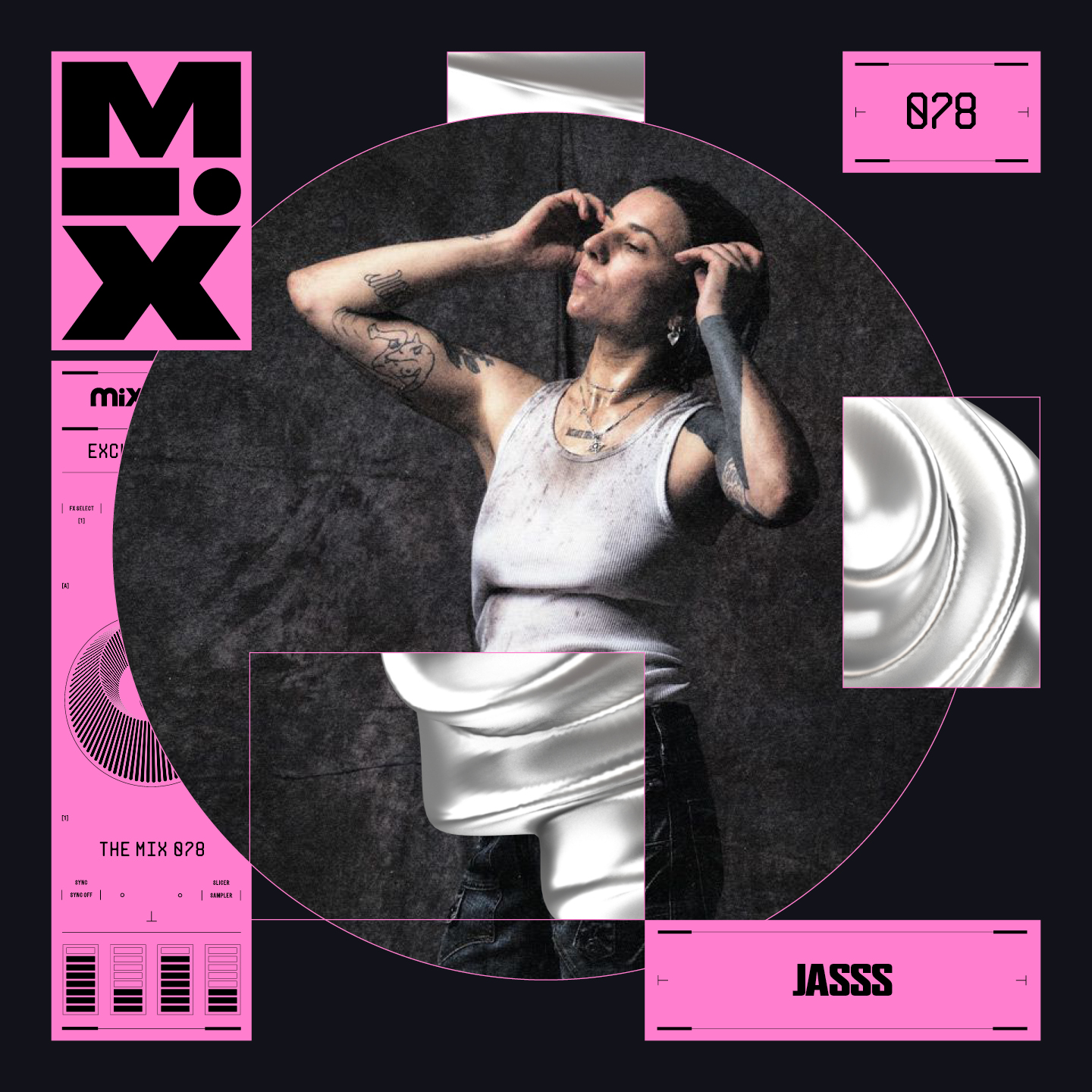
The Mix 078: JASSS
JASSS' new album 'Eager Buyers' is a breath of fresh air that subverts modern malaise. She speaks to Patrick Hinton about the devaluing of art, homogenisation of clubs, and shares a ranging mix that channels the feeling of playing on the Sinai Sound System
“Absolutely everything is an ad,” states Silvia Jiménez Alvarez, the Spanish-born, Berlin-based artist known as JASSS, when we connect to discuss her new album ‘Eager Buyers’. We’re a couple of weeks on from its September 2025 release, and a couple of decades on from the optimism of late-20th century capitalism vanishing past the millennium. “It was a promise of something that never came true,“ she said in the announcement text for the LP. “We put our faith in a mirage, and now we’re left in an existential void, struggling with a very real collapse.” The myth of endless progress has been busted. So JASSS has made an effort to regress.
“I was consistently exercising redirection of my attention,” she says of her headspace while making the record, aiming to shut out the bombardment of present-day emotional triggers and fixations, and tap into a deeper part of her core in a process she describes as “almost like meditation”. With the current conditions of global instability and rampant commodification of culture being a questionable context for creation, JASSS’ seven-track LP is a breath of fresh air. There’s no bending to trends or brain rot optimisation. It’s a layered, exploratory album that expresses her boundless sonic interests in immersive and uncategorisable forms. Field recordings and fragments of older works are weaved through its depths, forming a portrait of the artist that’s vivid and non-linear, existing all at once like a character from Arrival or Slaughterhouse Five. This is music to soak yourself in and truly listen to, fitting no other agenda. Not a response to modernity, but a separation.
‘Eager Buyers’ marks the inaugural release on JASSS’ new multi-disciplinary platform AWOS, which she aims to build with releases from herself and others. The name references ‘A World Of Service’, the title given to her 2021 album on Ostgut Ton, as well as a former residency on Berlin Community Radio and her live A/V show with the visual artist Ben Kreukniet. “It's a term that I'm very attached to because I feel like it's vague enough to suit me and my possible turns in direction very well. It resonates with me in a profound way,” she says.
Turns in direction are a feature of JASSS’ DJing, which sits apart from her production. She leans into high-intensity sounds and invites crowds to follow her through wormholes in the pursuit of a higher state of collective consciousness. Though this feedback loop from DJing has informed her understanding of the world in which ‘Eager Buyers’ has been released. She describes feeling like an outsider on the road, not participating in the dominant sound of “cheerfulness, an aesthetic kind of 'up up up'”, seeking to be more adventurous with her sets.
JASSS’ contribution to The Mix is inspired by playing on the Sinai Sound System at Draaimolen and shows her spectrum-busting range with 30 tracks amassing within the hour. In the accompanying interview, she discusses the devaluing of art, homogenisation of clubs, and shares what makes her hopeful in these times.

Where was your head at while making ‘Eager Buyers’ and how did that influence the themes and sound of the record?
I was preoccupied with instability in the world. I was in Berlin, and Berlin is a place that, in the last couple of years especially, made it very obvious for everybody how uncertain everything is. I guess that escalated my sense of 'I cannot see the big picture’ [the state of the world] — or I do and I'm terrified of it. That is definitely a state of mind that I was tapping in and out of, and that was covering a full layer of my existence at this time.
More specifically, I was consistently exercising redirection of my attention, and being very conscious of where I put my attention, monitoring the impact that that has on my output and my input, the internal process. Going into a little bit of a regression to maybe eight years ago when I released my first album, which is very referential for this new album, they're like cousins in my mind. It was a little bit of a time travel to remember, through my present lens, the person that did that record and what was my headspace then.
When you say you were redirecting your attention, what do you mean by that?
That we cannot be that naive to pretend to not be affected by the constant spam of tragic news, or very tailored characterisations of who an artist is. Everybody's a product; being fed this product, everybody's projection of success, trying to profit on social media from sadness, depression, happiness, success. Absolutely everything is an ad. I am conscious of that having an effect on me. That what I mean with redirecting, really trying to shut any kind of external projection out. It's almost like meditation, go to the core, centre yourself.
In the release notes you commented on the “capitalist hope” of the '80s and '90s, reflected in the album title ‘Eager Buyers’, and the “existential void” and capitalist collapse of today. How does it feel to be an artist in this economy and context that you describe? Does it feel your art is devalued?
The way I interact with that is that I am on the road a lot DJing and it's evident that there's a certain mood that is very much predominant and very much rewarded versus any other type, and that is cheerfulness, an aesthetic kind of 'up up up'. But in a way that is not necessarily profound. That’s the section of the industry that is actually growing and not decreasing.
The feeling I have is that I am more and more an outsider because I don't participate in the fanfare so much. I'm still there, but I'm just watching. Most of the time I don't even judge it so much, I have a feeling or two, but the way I see it is that I'm just examining what is happening. Even in nicher spaces like queer spaces there's a very homogenic way to perform queerness, and then the rest is the greyscale where music is more adventurous or more radical — which has nothing to do with BPM or intensity or hardness. It's just more adventurous, or, in general, more artistic, actually. And yes, I think the role of the artist is devalued because it has been commodified.
Read this next: Paula Temple's techno refuses to lie down
On the note of your relationship to club spaces, probably your raviest and most accessible anthem, ‘Turbo Olé’, was released in March 2020, just as clubs shut down for lockdown. It’s the sort of track I’d have expected to dominate dancefloors and possibly could have shifted your career that way to some extent. Instead it was released into a bit of a pandemic void. I’m curious if that impacted you in a way.
Having everything shut down when I released that track, I definitely had a moment of like 'for real?'. But it was quite short to be honest. It's a track that, actually, is not the best sounding on big speakers, because it's really full. It's a fantasy track. When I made ‘Turbo Olé’, it was really coming from a take on the Spanish dream of the club. In an anthemic, old school way, my focus was to try to capture what it is about that moment back then that was so romantic, uplifting or ecstatic — like why would you want to take pills to that, you know?
So for the sake of fantasy or the narrative of how everything unfolded, it kind of suits me well that it came out during the pandemic, because I also know that a lot of people during that time were listening to that track, were actually listening to that track, because they needed that feeling. They actually needed that feeling. Not like, 'oh that was a cool track, what's the ID?'. It was like: ‘I listen to this on my half an hour that I can go outside’, you know? So in that sense I think it went quite beautifully with history.
That's really sweet actually! Going back to the context of your new album, being genre-experimental and uncategorisable is anti-capitalist in a way. It’s not exactly a smart, calculating career move, and feels like authentic artistry to me. Does creating in this way give you a sense of autonomy, or perhaps even resistance?
I think I don't really have a choice. I do what I do, and fortunately I think I have quite a range when it comes to making. But the intention always comes from the same place, I'm not strategic.
In terms of what you’re expressing, are DJ sets a completely different approach to production for you?
Yes. My approach to DJing is high intensity. The best case scenario is: the size is amazing, the soundsystem is amazing, the crowd is amazing, and I'm completely one with them. My approach is an invitation to go places together, it’s a feedback situation. It's ritualistic. I've said it before, for me it's folk music, or at least the ritual is folklore.
DJing is a communion exercise, getting together in a way that is — not super "whoa spiritual" — but it's deeper than just escapism. I think it is worth it to not underestimate a crowd, because often they also want to go places. My approach is to find not-so-explored territories.
Read this next: “Dance music is folk music”: Why James Holden is still inspired by rave culture
When you're producing, how is the mindset different? More of an expression of inner creativity?
Yeah, it's more like that. When I DJ I have more of an intention of where I want to go, and you have a limited timeframe so you're changing your mind constantly. With music production, it's following a path that's revealing itself as you walk.

What are some of the field recordings you used on the album and what’s the intended effect on the sound or meaning?
For me, field recordings can sometimes have an effect where you don't even notice that it's there, but it adds a layer of meaning by inserting an actual situation. One that I might or might not remember, but if I do, I can recall the situation and am literally pasting that moment into a song that otherwise has nothing to do with it. It's a very overpowering ingredient in the mix to me. Maybe this just translates for the one that makes the music, but sometimes it's necessary to place it or contextualise it in a moment. It's almost subliminal.
It’s the first release on your new platform AWOS, what are your aims for it?
To get away with what I want to get away with.
Going back to the new album's thematic context and the dead dream of capitalist hope, do you think there’s a dream people are buying into now, or that's worth buying into? Or have we flipped into full-blown pessimism?
I think that people are getting really good at getting together and organising in a smaller, outside-of-the-system kind of way. There's more access to information, and people are being resourceful. Well, that's actually people in general, because it also happens with the extreme right. But because of the world working the way it does right now, it's very evident to more and more people that they have to seek alliance with the like-minded ones. I hope it is a realisation of a lot of people that they can become the pariahs that they previously thought it was impossible for them to become, and that generates a sense of urgency into connecting with other people. That's definitely where my hope lies.
I'm not a person that thinks that the human being is inherently bad, I think it just is. So I do believe people doing things independently or from smaller cores means a lot of good things can happen. And I see that more and more.
Read this next: Yosi Horikawa travels the world’s most obscure corners to source unique field recordings
On a day to day basis, what makes you inspired, optimistic, hopeful? In art and in the world.
It's kind of rare that a work of art makes me feel more optimistic than a simple interaction with a person. That's always the one thing that makes me feel optimistic in a way. Sometimes I just talk to people and they're really genuine and have ideas that I never thought about, or I did think about in a different way and they're completing them. Or they're very surprising and open a new perspective on a topic. Or I just learn from them, or it's a nice exchange.
Whatever a work of art is, it's just executing a vision artistically, but that can be transmitted with words already in conversations. I think those conversations have a very big impact on me, even in my body. I take a lot of value when people share information with me.
Can you tell us about how you approached the mix?
There's lots of range, but... I feel like I still didn't get over playing on the Sinai Sound System at Draaimolen. I still have it in my system; I think I'm still kind of there. When I was recording the mix, I still feel the residual feeling, I'm still channeling that.
‘Eager Buyers’ is out now via AWOS, buy it here
Patrick Hinton is Mixmag's Editor & Digital Director, follow him on Twitter
Tracklist:
Escaflowne - Acid Dawn
georg-i & Older Brother - Foundations
Devon Rexi - Khabe Bad
Slave To Society - FM Replicant (John Cohen remix)
Dwoopy - BRRAILE
Pépe - Frog Spirit
Sniper Mode - The Hooded Figure
Sawyer James - Time2G
Miki González – Tuquito en tu puerta (Dengue Dengue Dengue Remix)
Destrata - Body Break (ZDBT Remix)
Posture - I Wanna
Minosaur - The Fog
Terence Fixmer - Body Pressure
Jean Redondo - Yoko
Legion - Play That Vibe
MC Palakata & Tom Blip - Singeli Jungle
Auntie Flo - Paradise 23
SUCHI - Propeller
Aleksi Perälä - FI3AC2036080
Jasper Byrne - Meditation
Bougatsa Dream Tunnel - To Metro Tis Agapis
Cardozo, Gipsyan - Burning Question
Bukez Finezt - Putrefied Soul
Peder Mannerfelt & Dyslecta - Records & Vibes
primordial OOze - Living Body Map
Bad Sound & DJ Marfox - Both Twanche Riddim
Flore - Come Up
Magugu & Le Motel - Bitter Better
Actual - Ela Quicou
Limited Toss - Mind Of Hardcore 5
Osckrank - Tornado


