
 Music
Music
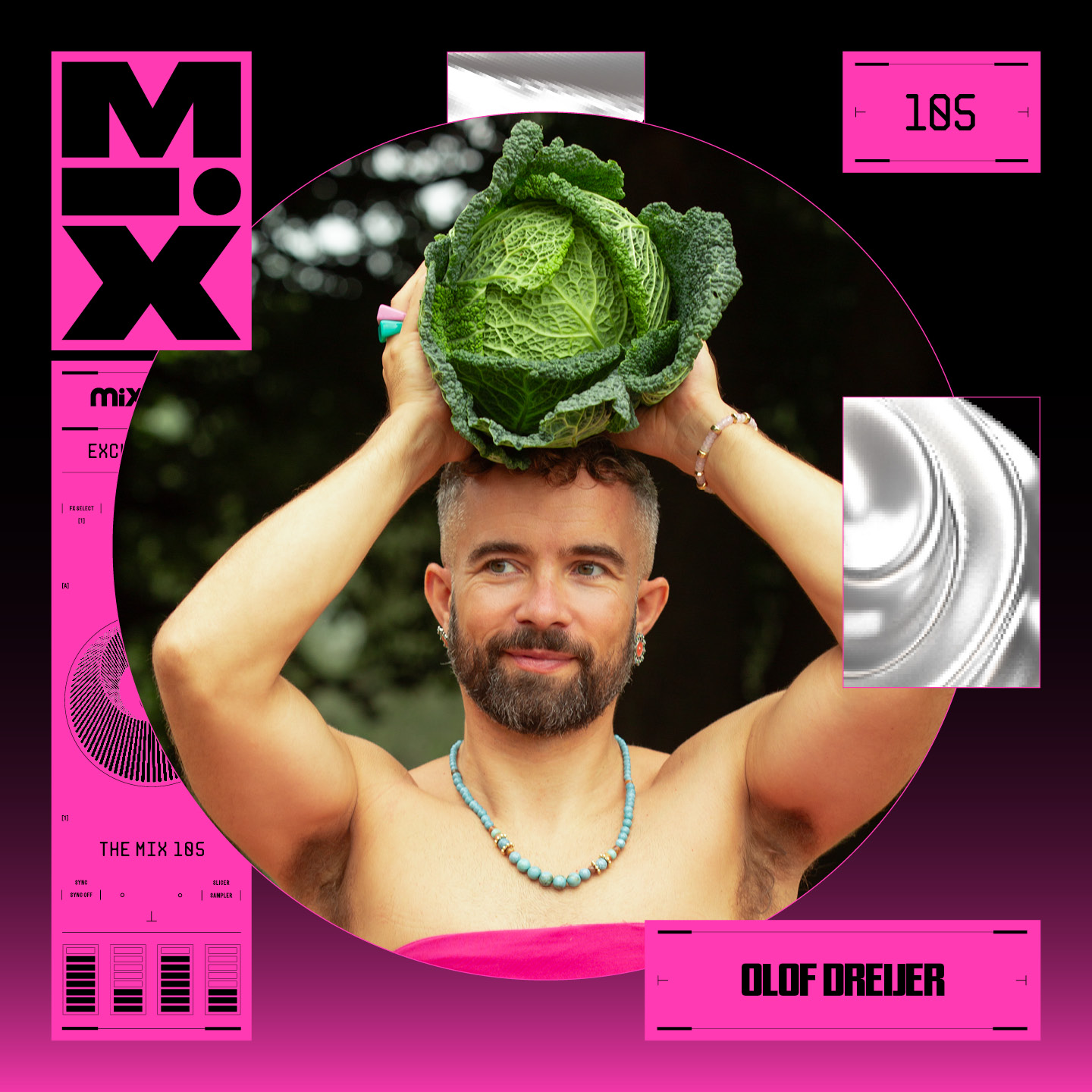
The Mix 105: Olof Dreijer
Olof Dreijer shares a mix of playful, driving club music and speaks to Christian Eede about his extended hiatus from releasing music and the fun he’s having returning to the dancefloor
The studio life of a solo producer can be a rather lonely venture. Spending hours in a small room, burrowing away at various synths or DAWs, asks a lot of one’s appetite for creativity. That’s just one reason why Olof Dreijer actively decided to take a step back from making his own music 10 years ago, and instead dived head-first into different activist pursuits and social work, while also opening up a music school for refugees in the Swedish artist’s then-base of Berlin.
This moment coincided somewhat with the decision of Olof and his sibling Karin Dreijer (AKA Fever Ray) to dissolve their joint project The Knife a year after the 2013 release of their confounding and brilliant final album, 'Shaking The Habitual', though he continued to produce music for other artists such as Tunisian multi-instrumentalist Houeida Hedfi and DFA Records affiliate Planningtorock for a few years after. Having launched The Knife with their self-titled debut in 2001, the following years saw the Dreijers develop a sound that mutated and challenged the boundaries of pop and techno, folding in all manner of experimental sounds – most notably on 2006’s 'Silent Shout'. In that time, he also built an arsenal of minimalist but memorable techno cuts that placed melodies, equal parts quirky and euphoric, front and centre under the solo Oni Ayhun moniker from 2008 to 2010.
Dreijer’s hiatus a decade ago also came at a time when he was asking himself some significant questions about his own place in a markedly white, male-dominated music industry. “I was being quite hard on myself,” he says now of that time from his current base of Barcelona. “I was internalising some very complicated, structural power imbalances, which was quite weird of me because usually I don’t feel that you should take on these big concepts alone.” Having spent a number of years living life, teaching, and enjoying a more social approach to his work, he soon found himself yearning once again for the studio, where he could explore his imagination in musical form. “I slowly started to make some dance music on my own as a hobby,” Dreijer says.
His creative juices quickly started flowing, arriving at a sequence of EPs that have dropped on Hessle Audio, AD 93 and Dekmantel over the past few years. Now, we have an album, 'Loud Bloom', on Dirty Hit spin-off dh2. With a career that spans more than two-and-a-half decades to his name, you might consider it a curious detail that the LP marks Dreijer’s solo full-length debut. Formed of tracks from those aforementioned EPs – some reworked, and others appearing in original form – as well as a number of brand new cuts, 'Loud Bloom' is lavishly colourful. Its synth melodies unfurl like kaleidoscopic light, carrying a distinctively Dreijer touch that harks back to classic Oni Ayhun material like 2009’s ‘OAR003-B’.
To mark the new album’s release, we caught up with the artist to talk through his self-imposed hiatus and return to the dancefloor, as well as his desire to be open and upfront as a musician, and plans for the future, which are already in motion. You can read the conversation below, where you can also find Dreijer’s instalment of The Mix, which explores the kind of playful, driving club music that you might expect to hear in one of his DJ sets.

I wanted to touch on your time in Berlin, because obviously its dance music culture stereotypically has this very serious and greyscale vibe attached to it. I feel like your music is the antithesis of that; it’s very melodic and colourful, and doesn’t take itself too seriously. Did your time living in Berlin influence you musically, in wanting to push against that?
I moved there when I was quite young and being there shaped me a lot. Initially, I was at Berghain almost every weekend and I loved a lot of that culture. Usually what I do is a reaction to something, though, and I started to react against that at the same time as loving a lot of it. There can be more colour, fun and cheesiness in this music. I like to play with things that are maybe considered quite kitsch, and it’s fun to do that. At the same time, you can hear that I love this techno that I react towards.
It sounds funny to call 'Loud Bloom' your debut solo album, because your discography stretches back across multiple decades. Why did you decide that now was the right time to put out an album under your own name?
It took me many years to land in this place where I felt it was fine to go for my own music. I had a long break, and that time was necessary for me to realise that I could have more fun with my own music. Doing a solo album would never have been on the table 10 years ago, because I took a break from making my own music. I got more into doing social work and I started a music school for refugees in Berlin. That was happening alongside myself being involved in activist settings, such as feminist and anti-racist organisations. They included cultural and activist projects. This was all happening while I was asking myself if my voice was needed in a very white, male-dominated music industry.
I went back to Sweden and did more of that activism. I worked in youth clubs and studied to be a youth worker. I was also taking time away from music because I asked myself if I wanted to spend time alone in a studio for my whole life. I felt like there was more to life than doing that, so there was also a genuine wish just to be around other people more. I was learning a lot from doing workshops, and teaching teenagers and young adults. I had a lot of fun with that and did that for a while, so it was a very exciting period in many ways. After a few years, though, I started missing making my own music, so I slowly started to make some dance music on my own as a hobby and now here I am with the album.
When announcing 'Loud Bloom', you said: “After taking a break I’m very happy to have arrived at allowing myself to just have fun with my own music again.” How did you arrive at that place?
During that period I was talking about, I was being quite hard on myself. I was internalising some very complicated, structural power imbalances, which was quite weird of me because usually I don’t feel that you should take on these big concepts alone; I believe strongly in collective action. Now, I’ve realised that it’s too big an issue for me to handle alone and that I can still challenge these concepts while making my own music. I’ve been really surprised to be having so much fun just making dance music. I was really focused on making melodic and cheerful dance music for this album, and now I’m already looking towards the next chapter, in which I want to come back to the techno that I was exploring maybe 15 or so years ago. I’m getting more into simple and darker techno now, so it’s funny how cyclical these things can be.
During that hiatus that you took from making and releasing your own music, were you still listening to and keeping tabs on dance music, or attending club events?
Yes and no. I always continued going out of course, and I love to dance, but I was not so up to date on everything. I was very bored with what was going on, and I was so bored with techno – especially in Berlin at the time. I got more into releases from labels like Príncipe, as well as amapiano, as it was all coming up in around 2015.
You came back a few years ago, and started putting out the EPs, with the first one being 'Rosa Rugosa' on Hessle Audio, and then others followed on AD 93 and Dekmantel. Those are three of the most essential labels in that specific corner of electronic music, so how did those releases and connections come about?
I must credit my management for that, because I don’t have the skill to think about strategy. If I was handling it myself, I probably would have released it all on Rabid, mine and my sister’s label. My management had the idea to reach out to others, and I’m so grateful for their advice because it gave me a chance to start on a fairly new slate and do something a little further away from the connection of The Knife. I’m so happy that these labels were interested and I hadn’t followed all of them so much before, so it’s been a real eye-opener.
Your music has always been very richly melodic, even stretching back to the Oni Ayhun material. Do you feel like a lot of modern club music, and especially techno, can be too serious and lacking in melody or colour?
I still also really like the more simple techno and it’s really difficult to make melodic music that retains the essence of techno, so I understand that there are very few people doing that. When you make it too melodic, it can become quite cheesy. I like to give myself difficult tasks, though, and it certainly is possible to squeeze more warmth and melody into this sound. For example, take a track like [DJ Rolando’s] ‘Knights of the Jaguar’, which is such an essential piece of techno. There are very few tracks that have found the perfect balance of inserting melody fully into techno, but that is a good example. It’s such a classic, and many DJs continue to play it now. It’s an exciting area for me to explore more.
Talk me through the album’s title, 'Loud Bloom'.
It ties in with the idea of allowing myself to stand at the forefront of what I’m presenting now. That is the loudness in the title, while the plant theme comes from myself seeing my tracks as my little babies that I’m nurturing. I always have difficulty separating from them and sharing them for other people to hear, so that’s why I came up with this concept of giving the track titles dual meanings of being the names of people and plants.

Why do you feel that you struggle unleashing your tracks and sharing them with the world?
There has always been a process that whoever works with me may get very annoyed with me. They might come back to a recording session with me, and I’ll have done five new versions or production suggestions of what we originally created. It really comes from a point of love for making music, but sometimes I have too much patience. These days, I am a little faster, but I have always worked quite slowly. My process has improved, but when doing The Knife and some of my earlier solo stuff, I definitely created a lot of different versions of ideas I had. I don’t like to repeat old ideas and keep doing what I’ve already heard, so it can take some time. I’m technically much better now having had so much experience so that makes the process easier, and I feel that I’m more clear now in what I want to express.
Did you specifically set out to make an album, or did 'Loud Bloom' come about more accidentally?
It definitely wasn’t an intentional process. I just started making some music, and I didn’t even think of putting it together as an album at first. After making the EPs, though, I felt it made sense to compile some of that material together with some newer material. It feels nice to hear it all collected together, because the tracks really work when listened to in the same context. It’s nice to use this album to close a chapter before I move onto the next one. The album isn’t even out yet, and I will tour it for some time of course, but I’ve already arrived at the next chapter.
I’m really enjoying making techno, but in my own way. 'Loud Bloom' is very much concrete – meaning not so abstract – and now I’m moving into slightly more abstract, but still melodic, territory. It’s super functional to my ears still, though, because I’m not abstracting the beat. I’m reacting to what I’ve done before, and moving in a different direction, while still squeezing drama and emotion into the style of techno that I want to make.
I know that you build your own sounds when making your music, and you’re not really someone who produces music from external sample libraries. Why is that?
I always look at sample libraries when they are released but I just never find the right sound that I like. I end up playing everything by hand. Somehow I feel like I need to have a relationship with an instrument. For example, recently I have been playing with a lot of beer bottles to produce sounds. Depending on the mallet you use to hit them, you can generate so many different sounds from them. I bought five different beer bottles and I don’t even drink beer, so I’ve had to research different brands. It ended up being Corona that gave me the best sounds. It was tuned in the right way somehow. It often sounds so cliché to talk down on sample libraries because they are good to make music production accessible for people, so I’m not dismissing that. I probably could use more sample libraries to make my production process more efficient.
Read this next: 10 tracks that prove MF DOOM was the master of samples
You’ve worked with three different vocal collaborators on the album, in MaMan, Diva Cruz and Toya Delazy. Is it a conscious decision to work with more non-Western voices in your music?
To be honest, I don’t really think about it so much in those terms now because that’s just my start-out point. It’s maybe a subconscious decision, and these collaborations actually came about very organically. For example, Diva contacted me and asked if I could help her make her first productions with her own vocals on them. I knew her previously before as only a percussionist because she played as part of the Fever Ray live band. Toya had heard my recent tracks but had never heard about The Knife. She contacted me and suggested that we do something, which was really fun. The MaMan track came about from myself hearing his tracks and trying to work them into my DJ sets, which then led to me reworking his song ‘Dafnino’. I tried to make all kinds of mash-ups of his vocals with other songs, but it never really worked, so I just worked on my own remix. He liked it a lot and recorded some additional vocals, so it grew over time into something new. They all came about very naturally and I’m very grateful to have met and collaborated with these people.
You just said that you try not to think too politically now about everything you’re doing musically, but I know that you have a deeply political background given all the work you did on your hiatus from music, and The Knife were always viewed as being politically-minded act. Is making this colourful dance music now your opportunity to break away from those expectations from your past?
It’s not that I don’t try to think about the political elements of certain things, but rather that they come more naturally to me now. In the past, I might do a DJ mix and make a conscious effort to include at least 50% of tracks by female or non-binary artists, whereas now I don’t need to think so much about that because I’ve been conditioned to follow these artists anyway so their music naturally ends up in my sets or mixes. It’s also not as difficult these days to ensure that you are adequately representing different identities because it’s such a different time.
The main change for me in recent years is that I now do my activism on the side of my music work. I do that in my private life, and I use the great power of music to give myself happiness and energy. I’m so grateful that I can do that, because activism is not always so easy. In the past, with The Knife, we felt the need to squeeze a lot of ideas, politically, into the music to make them protest songs. That’s not so much the focus with my solo music now.
Did you ever feel like The Knife got pigeon-holed in that way into there being an expectation of making these protest songs, and producing music that has a very political meaning?
Weirdly enough, I never got affected by expectations. I felt that I was in a privileged enough position to not have to think about what people expected of us so much. Maybe the only time that we did take expectation into account was that there was a period where we were seen as some kind of mystical act. We were just having fun and playing with masks and costumes. I found that people saw us as quite anonymous and mystical because of that, but that was never our intention. Maybe that’s why I’m more open and upfront now, because I don’t ever wish to be mystical. After many years of teaching and doing workshops with teenagers, I feel like it’s far more important to share what you know and be open with others.
Can you tell us about your mix?
I tried to squeeze in as much variety as possible in an hour; some live mash-ups with rappers like Little Simz and Fat (Nwigwe); many layers of rhythms and styles together: R&B, house and tribal techno, and some of my new tunes as well.
'Loud Bloom' is out on May 8 via dh2, pre-order it here
Christian Eede is News Editor at The Quietus and a freelance writer, follow him on Instagram
Tracklist:
1 Rochelle Jordan - Ladida
2 The AM - Black Majik
3 Leikeli47 - Bad Gyal Flex
4 DJ Bone - We Control The Beat
5 Little Simz - Thief (Vocals Acapella)
6 Olof Dreijer - Plastic Camelia
7 Grain - Untitled B2
8 Tobe Nwigwe - EAT (feat. Fat Nwigwe) (Accapella)
9 altrice - think & dream
10 Ayesha - Rezo
11 El Mago - Brasileña
12 Leod - Untitled 05
13 WOST - Batucada
14 Olof Dreijer & Toya Delazy - Makwande
15 DJ Urban Fuckin' Beat (DJ Ze MigL Remix)
16 MEDLEY DJ R7 - Rainha dos Fluxos (feat. MC Dricka)
17 Regal86 - Estática
18 French II featuring Agboba - Run It Red
19 Olof Dreijer & MaMan - Echoed Dafnino
20 Talismann - MATAM
21 Gene Richards Jr - Broken
22 Fergus Sweetland - Crab Man
23 Nørbak - Suave


