
 Music
Music
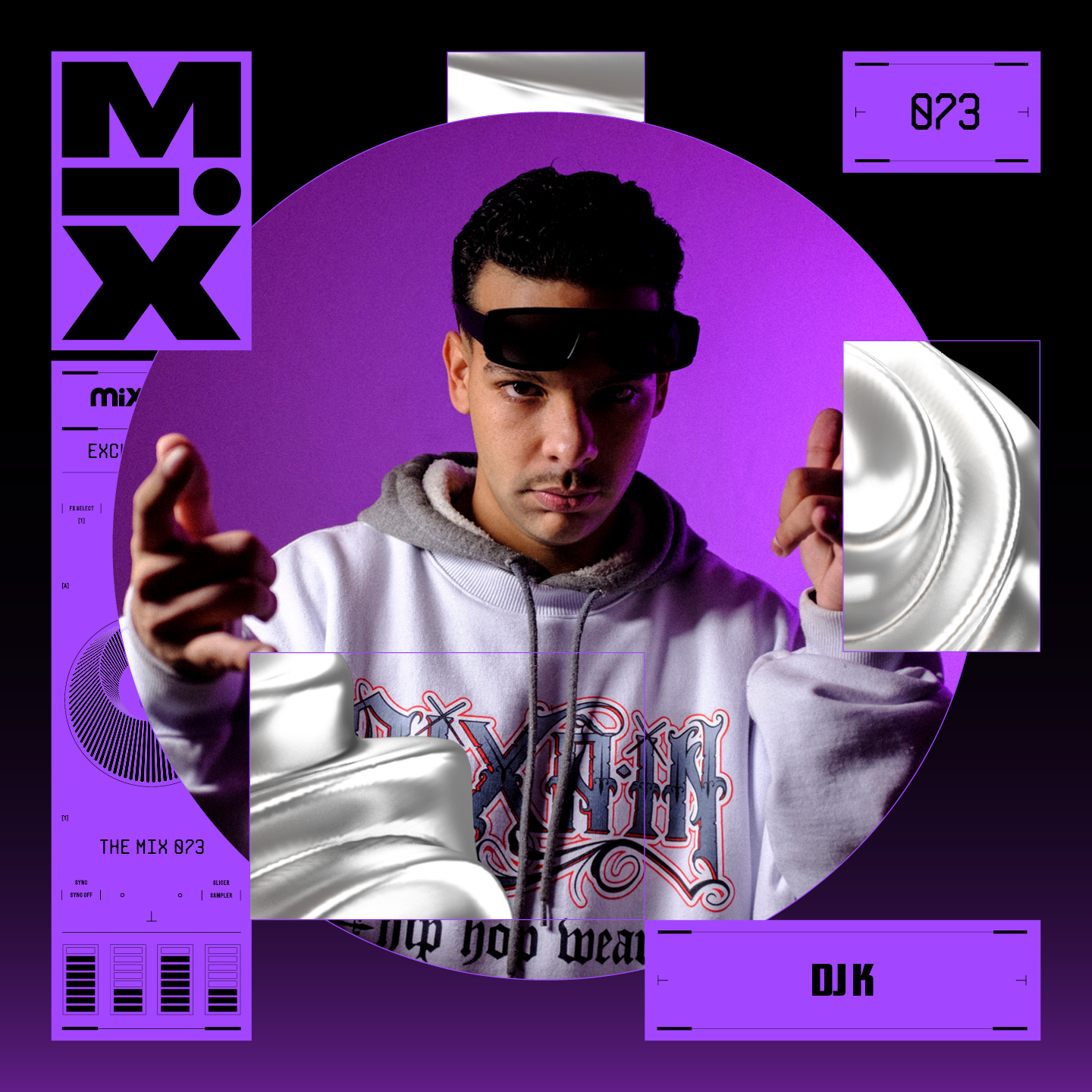
The Mix 073: DJ K
On his second album, Brazilian bruxaria figurehead DJ K builds on the international acclaim of his debut, turning his attention to legacy and social change. He speaks to Nathan Evans about state repression of Brazilian funk, freedom fighting — and shares an exclusives-heavy mix
Most club producers organise sounds in a digital audio workspace (DAW). Others throw their efforts into a modular synthesiser setup. For São Paulo producer DJ K, it’s a cauldron.
As his trademark producer tag goes: “DJ K is no longer producing. He is doing witchcraft!” — a reference to his style of funk mandelão called bruxaria (Portuguese for “witchcraft”). Like mandelão, he concocts sampled sounds — anything from Arabic strings or baile funk’s trademark whistle sound (assovio) to a child’s voice — into a pointillistic tune stuck in an evil-sounding key. He overlaps this with MC vocals and the giggling of pixies and imps, adding jackhammer techno kicks that sends everything ragdolling. But the key to DJ K’s bruxaria is a high-pitched frequency that mimics the ringing sensation of the popular street drug lança-perfume (AKA loló), and makes Aphex Twin’s 'Ventolin' sound like ambient music to sleep to. K’s music is a black hole to be sucked into, its components hitting on-cue each time but with the angle titled and stakes raised. As one YouTube comment put it, “1L of loló is not enough” for his DJ sets.
The otherworldliness - or, rather, underworldliness - of K’s music belies the very receptive way he creates it. Born in Diadema, near the São Paulo favela of Heliópolis, his first publicly-released track notched over 10,000 listens through vigorous sharing on WhatsApp. As his tunes became noisier, they also became sharper for internet attention spans. Once he found a majority of his YouTube viewers switched tracks after 40 seconds, he made those first 40 seconds as immediate and ever-changing as possible.
Get in The Mix: Shop the Mixmag range here
Years into his regular gig at the Baile do Helipa, one of the city’s biggest parties, K saw international success with his debut album, 'PANICO DO SUBMUNDO'. Produced in only three days, the album was all the better for its immediacy, presenting a pure look at how bruxaria visualises the surroundings of favela life into a circus nightmare with smoke-machine fog, banshee electronics and killer clown imagery. Putting funk mandelão in an album format caught the ear of Western publications, putting K forward as an international figurehead for bruxaria.
It’s hard not to describe the music of DJ K without sounding like a tyrannic warlord. Indeed, club music is described so often in violent terms (weapon, banger, bomb, and so on), but in the favelas, silence is a sign of police violence, according to Rio de Janeiro DJ Renan Ville. Noise represents safety from authority, and therefore so do bailes, but even this is being threatened with council officials wishing to disperse parties with “sound cannons”.
Rarely is club music used as a call to violence, but on his new album, 'Radio Libertadora !', K uses the historic calls to arms that have changed the course of Brazil’s history to channel that energy into today. Taking two-to-three months to complete this time, the LP is named after a radio station that became a voice for the voiceless during Brazil’s military dictatorship of the '60s, '70s and '80s. Funk can be lyrically and sonically combative, but 'Radio Libertadora !' tackles it at a thematic level. “The album portrays the fight for freedom of classes and of the people on the periphery,” he tells me over Zoom.
He expands his stylistic repertoire with ventures into mega funk - the favela’s answer to slap house - on tracks like 'ALI PERTO DA IMIGRANTES', and diving into a vat of deep techno that could pour from a Berlin nightclub on 'A TROPA DO'. Bruxaria is still the key driver of the album, but in a mutated form to let the MCs lead the way with tales of escaping police raids, lamenting the violence in the favela and access to education, and the ever-present commands for the baile to descend into mayhem. With it, he continues the message of the original Radio Libertadora: your voice is a weapon.

What was life like growing up in Diadema, then later, Heliópolis? Did you get into funk early as a kid?
I always listened to funk music because I lived in the favela, so there was always funk playing. I started going to Heliópolis when I was about 17 years old to play and put into practice the music I was making at home. Even the older songs inspired me to create this new version of funk, and even now, I still listen to funk because it’s so strong in the favelas.
Tell me more about Baile do Helipa, what makes it the best baile? How often do you perform at Baile do Helipa?
I wouldn’t say it’s the best. It’s just the baile where I grew up and felt at home. It’s definitely one of the biggest bailes in São Paulo, but not the very biggest. People here often focus on just one baile for a while, then the scene shifts and everyone moves to another. That rotation happens all the time. But for sure, Helipa is the strongest when it comes to bruxaria sounds.
Helipa is more accepted by young people in São Paulo because it's a street party, it's free, everyone can go and you only pay for what you consume in the bars and so on. Not many can afford to go to big clubs and expensive clubs, so they go to the Baile de Helipa.
When I started going out, I always went to Baile de Helipa, but when I started to become successful playing in clubs and private venues, I began to have a different perspective on both society and music. But, even after touring Europe, I always went back for a weekend in the favela, in Helipa, where I always liked to hang out. This year, I decided to focus more on the album, but I still go at least a few times a month.
Have you had to deal with police at Baile do Helipa?
The police are very regressive, because here in Brazil, bailes are a youth movement that's being repressed by the state. The laws don't allow loud music and crowds in the middle of the street without a state permit, and the Brazilian laws don’t allow sounds after 10:PM without the consent of the state. Recently, this repression against funk dances has been getting worse. They bring cars with big sound boxes to disperse people.
Read this next: The UK loves baile funk — but does it understand it?
What times does the Baile do Helipa run across?
From 11:PM to 7:AM, all night long.
How do you prevent the police from intervening with the baile when it’s past 10:PM?
We don’t intervene or cut any deals ourselves - usually that’s handled by the bar owners. The baile almost always goes ahead, though once in a while they don’t let it run all night.
What sparked the idea for 'Radio Libertadora !'?
The first track was definitely crafted and well thought-out. It has the entire context of what the entire album wants to convey. People will get the meaning after listening to the first track.
What appears on that track?
Carlos Marighella appears speaking on Brazil’s dictatorship and at the time of this speech, it was broadcast on Rádio Libertadora, which was at the time against the military. The name of the album is the name of the radio station that fought against the dictatorship.
The album portrays the fight for freedom. It's freedom of both classes and of the people on the periphery. What I wanted to portray was the cause for freedom - the freedom to do what you want, to have financial freedom, to have freedom in all kinds of areas.
Compared to your first album, you recorded this album in a much calmer state financially, you had less personal life to figure out. Did having more time to focus on material change how you made music?
I was working at an IT company for the first album, and I didn't have much time to stay home producing things or thinking much, so I made it in three days. The second album, which is this new one, I made more thoughtfully; it took longer to make. The MCs wrote with the theme of what I wanted to convey. The first album was a cry for help in society, and the second album is a cry for freedom.
Read this next: 10 crucial tracks telling the history of São Paulo's baile funk scene
Funk is a constantly shifting ecosystem, often changing in the span of one month. How does that factor into crafting an album over the course of several months? How do you go about making something timeless in an ecosystem that’s so quick to evolve?
I tried to maintain my originality as much as possible, but I definitely included current things on the album. For example, new samples and beats. Funk really changes fast, but I try to maintain my personality, that’s what makes me, me.
Nyege Nyege Tapes pressed your album on vinyl after it was released, but this album had the vinyl release simultaneously. Did you consider the physical record when you were making the music or was it still concentrated on the online presence?
At first, I was a little shocked initially to see my music on vinyl, because here in Brazil, we don't have that vinyl culture anymore, it's not popular here. More people want to collect and such, or leave it for decoration, but the vinyl production was the investment of Nyege Nyege.
There’s a lack of tuín whistle on this album, where it was so prominent on 'PANICO DO SUBMUNDO'. Was that a conscious choice?
Yes, it was intentional. I wanted to change things up a bit, to do something new. I wanted to make this album more original and break away from the aesthetic of the previous album.

Getting into specific tracks on the album, 'ALI PERTO DA IMIGRANTES' is a mix of mega funk and Miami bass. How was the change of style for you?
That was a product of what I was listening to at the time. I was listening to a lot of tech-house, a lot of the sons of rave, like DJ Bratti SC and Duarte, so I wanted to put a bit of that in the song. In Brazil, people are really enjoying this type of sound.
What I was listening to most was Brazilian mega funk music, which is a genre from Rio Grande do Sul that is spreading throughout Brazil. I was talking to my friends one day and they showed me mega funk. The production is totally crazy, and the producers often don't have managers or labels. It reminded me of myself. Our people are getting their feet into the industry with no background.
On 'BEAT SUGA ALMA', there’s a child’s voice in there, it’s very distinct. What does the child say?
It goes: “4+4 is 8, minus 3 leaves 5, mama me and my friends.” It’s one of the most widely used acapellas in Brazilian funk. It’s a track by a friend that became very well-known all over Brazil, it turned into a national hit, so I decided to include this acapella of his. Today, he’s 25 years old, but at the time he was still underage. This voice is heard at every single funk party without exception.
You shouted out Racionais MC’s on this album, tell me about what they mean to you.
Since I was little, I've always listened to Racionais MC’s and always had all the references for life, for living in the streets, and for knowing what's right and what's wrong. I learned, most of the time, from their music, where they convey a worldview to young people.
What’s your favourite song from them?
'Jesus Chorou', which translates to 'Jesus Cried'.
Do you think that the underworld of bruxaria has had an effect on mainstream funk?
Without a doubt, bruxaria is the most popular funk genre in São Paulo today and is becoming one of the biggest in Brazil. It started underground and spread to mainstream media.
How does the upper class in Brazil see funk mandelao? I imagine the genre has faced plenty of prejudice…
They see it as if it were music for those who don't have culture. as if it were music for those who are lazy and don't want anything with life. But even in the upper class, it's becoming music consumed in their clubs and parties.
When I interviewed DJ Ramon Sucesso a few years ago, he said the reason São Paulo has become the key funk city because its artists are more united. Do you see that from your perspective?
I’ve always worked mostly on my own, but the artists are really united - to make music together, shows, and even hangouts not related to music. We’re very close because of funk.
Read this next: Get to know DJ Ramon Sucesso, the viral sensation shaking up Brazil's baile funk scene
How was the experience going to Europe on tour? Did you learn anything new about Brazil while travelling somewhere so different?
It was an incredible experience. I learned that the world isn't just within São Paulo. Some of the main countries I liked were England, Portugal and Poland. They were places where I learned a lot about the culture, where I spent a lot of time, and that I took away as a learning experience.
What do you do when you’re not producing?
Playing video games, smoking marijuana, going to the streets, flying kites and playing soccer.
What would you say your impact on funk mandelão is? What do you want it to be when all is said and done?
First, I want to be able to be financially stable to help my family, and I want to leave a legacy of being a person who fought for causes through funk, as a way to be heard among young people. Being successful made me stop and reflect that I can change a generation or I can do something bad to a generation. I have this power in my hands, especially to be known, to be recognised internationally. My vision is this: being a DJ has always been my dream, but using it to fight for causes is even more satisfying.
What can we expect from the mix?
I made a mix with my songs from the new album, of course, but my main focus was to include exclusive tracks that I haven’t released on any platform yet. I hope you enjoy them - these will be some of my upcoming works. I also added the tracks I played the most at Helipa throughout all these years. Hope you like it!
'Radio Libertadora !' is out now, get it here
Nathan Evans is a freelance music journalist, follow him on Twitter
Tracklist:
DJ K - Rádio Libertadora
DJ K - Vou Cair Para As Alamedas (Exclusive Track)
DJ K - Renk Renk 2
DJ K - Já Pensou Se Essa Moda Pega
DJ K - Untitled (Exclusive Track)
DJ K - Mega Putaria (Exclusive Track)
DJ K - Armamento Estrangeiro
DJ K - Puta De Silicone
DJ K - Untitled (Exclusive Track)
DJ K - Boladão Fumadão
DJ K - Beat Magrão Pra Comer Xereca
DJ K - Tuin Destrói Noia
DJ K - A Ex Do DJ K Ta Ligando
DJ K - Automotivo da 17 (Exclusive Track)
DJ K - Ta No Helipa


