
 Music
Music
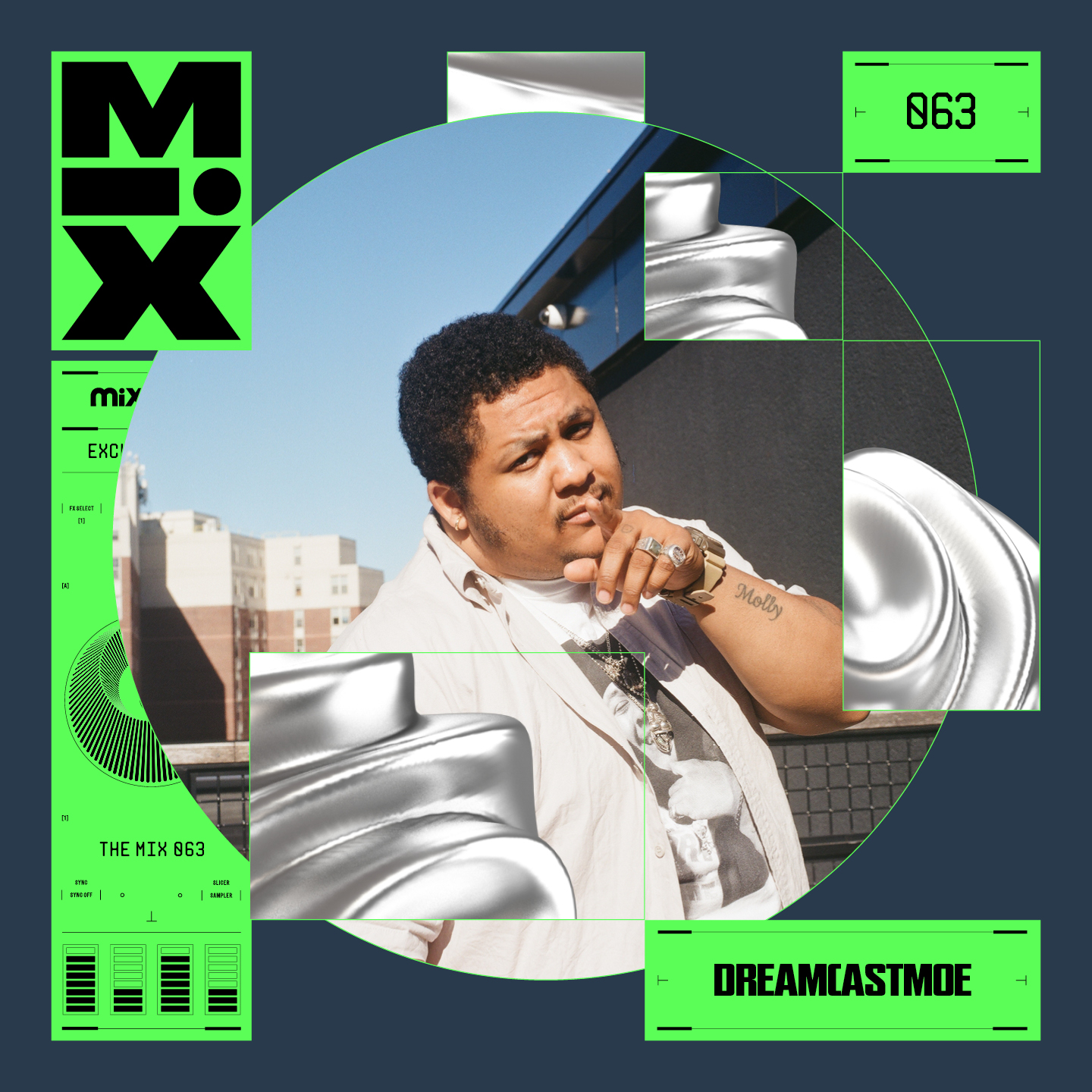
The Mix 063: dreamcastmoe
The Washington D.C. native gets down to business in a blissful new mix and talks about his new ‘Lost Tape’ album, how he straddles the sounds of soul and club music, and how early exposure to go-go performances allowed him to find confidence in freestyling
dreamcastmoe’s productions sound like stepping into a live jam session on a humid summer evening. Stamped with his signature ad-libbed vocals and freestyle instrumentals, each track has a way of making you feel like you’re witnessing the magic of live performance first-hand. The Washington D.C. native, who serves as a singer, songwriter, DJ, producer, and multi-instrumentalist, thanks his early exposure to go-go music – a funk sub-genre that emerged out of D.C. with a focus on call-and-response styles – in laying the foundation for his sound today. “Without go-go, I don't think I'd ever feel comfortable being up on stage with a mic without needing to be overly prepared,” he explains.
At home in the studio, dreamcastmoe embraces that same spontaneity by inviting friends in to work on new music, while his nonchalant style of talk-rap over his tracks pay homage to house legends like Ron Hardy and Chez Damier, utilising his voice “like an instrument”. Across his releases, dreamcastmoe blends the warm chromas of soul, funk, house, and old skool hip hop, which have so far lined labels from Ghostly International to Future Times, and most recently, his first outing on London’s Rhythm Section.
Formed over the course of a year, his latest record, 'The Lost Tape Vol. 3', came together “naturally” with the help of producer and engineer BlackMoses, and marks the third release in an ongoing project – a series of mixtapes that he describes as “genreless and formless” – featuring 13 tracks packed with off-the-cuff collaborations. “I would just have the homies over, and I would be writing, playing on the drum machine, and messing around on the keys,” he explains.
We sat down with dreamcastmoe to chat about his new record, the art of spontaneity, the closure of venues in Washington D.C., and how early exposure to go-go performances allowed him to find confidence in freestyling. Check it out below, alongside a blissful new mix going deep into soulful house and funk.

The last time you spoke to Mixmag, you were just releasing your 2022 album, ‘Sound Is Like Water’. What have you been up to since then?
Since then, I've taken a step into starting my days earlier, and how I make time not just for writing, but the production of a project. A big part of that is waking up with a clear head – over the last two years I've stopped drinking. That’s probably one of the big changes, and collaborating in a way that is more home-based by having friends come to my place to record and work on music in a way that's just very comfortable. It makes it so that the music I put out is fresh and in the moment. The home studio is really where a lot of the moments happen for me now – they're not just on the road.
Washington D.C.‘s dance music scene doesn’t seem to get as much global recognition as cities like Chicago and Detroit. What was your experience growing up around music there, and how has the scene developed since you were young?
I grew up in a Black queer household, so a lot of the electronic music that I first heard was from my mother’s tapes and cassettes. Shout out to Black women for putting me on to some of the best music I have ever heard. My mother, my aunts, my godmother, they would be in the house cleaning and moving around to some of the best house music. Even now, I think back to some of those moments.
The women that I had in my life were 10 years ahead in terms of what they were listening to, mostly because my mother worked at the door of a well-known club on the East Coast called Tracks. Tracks nightclub was renowned, it had a volleyball court and basketball court inside the club. My mother would tell me that you’d go into the club at 6:PM and leave at 6:AM the next morning. It was the closest thing to what Europe does now. This was a time before a lot of the big sports teams came – the reason the club district and those spaces aren't around anymore is because a lot of those club owners sold the land. The space where Tracks sat is now a baseball stadium; the Washington Nationals play in the surrounding area.
Over the years a lot of these club spaces, especially spaces that were open and accepting of all walks of life, no longer exist. Now it's more mainstream venues that have less focus on the minority of people who go out and want to enjoy nightlife and feel safe doing that. I'll say real estate has re-mapped what nightlife is like in D.C., and that's a big thing. Gentrification is the key word there.
You’ve said before that you grew up going to open mics in D.C. where you would jam with other like-minded people — did those experiences inform the way you perform live today?
Absolutely! D.C. has its own style of music, and big shout out to go-go music. Without go-go, I don't think I'd ever feel comfortable being up on stage with a mic without needing to be overly prepared. I think there's a lot of energy with go-go music that is spontaneous and in-the-moment. A lot of that energy I got from being outside listening to music live, a lot of the free expression that I present when I'm not just on stage, but when I'm in a DJ booth, my comfortability on the microphone comes from just how natural a lot of the go-go performers were on stage and on the microphone. It's like they can control the crowd, whether it be 20 people or 2,000 people; they're going to talk and they're going to get people's attention.
‘The Lost Tape Vol. 3’ is coming in June, some 6 years since the last iteration. How has your style developed and changed since then? Will this record act as a follow-up to that last edition?
You know, I think the ‘Lost Tape’ series is specific to me feeling free creatively, not just limiting myself to any particular sound. All of these different genres and spaces that I touch, they're all a part of me. They're all part of who I am as a person, because I grew up around so many different types of music. As I get older and I mature, I'm still hearing forms of music that I’ve never heard before, different artists and international pockets of sound and rhythm, so now I'm playing with that as an artist and writer.
The ‘Lost Tape’ is going to be a place where I’m honing my craft and finding the things that excite me within music, and that’s a genreless and formless space. The original play on the ‘Lost Tape’ name is that it’s called a tape, but it's printed on vinyl, and it looks like a CD – it was just a joke on a joke on a joke.
What was the process behind making this one? How were you feeling as you were making it, and where were you pulling inspiration from?
I’ve been cooking up ‘The Lost Tape Vol. 3’ at home over the past year, inviting my friends like BlackMoses, Ruqqiyah, NAPPYNAPA, AUTO LOLA, Jelani Kwesi. I would just have the homies over, different times and different scenarios, and I would just be writing, playing on the drum machine, and messing around on the keys. Big shout out to Moses who's on the production, he engineered the tape and we really built a friendship and bond throughout the creative process – it was just very natural.
On a lot of the songs, we would just start recording and be like, “Okay, we got to finish this,” or, “Let's keep cooking this up.” We made three or four songs within the course of six or seven hours. It was like being in the gym as Kobe Bryant – every shot you take, the better you get, so that was my process with the latest tape. I'm going to improve my craft and master my writing here.

‘The Lost Tape’ series is said to pay homage to pirate radio and go-go funk, can you tell us more about that?
Absolutely. It gives a nod to a lot of the early morning radio that I grew up around. As a child growing up, when I would go to school, a big part of my morning was radio. It would be on in the house, and then it would be on in the car when I would go to school. You would hear songs that you’d never heard before, or mixed in an interesting way by the DJ. It was exciting to hear something that I hadn't heard before, from a new voice.
There’s also a nod to go-go music for always being unapologetically D.C., pushing the boundaries and not being afraid to remix or sample from different genres of music to make it their own.
The album is landing on London label Rhythm Section, how did that come about?
I would say through a very organic friendship with Bradley Zero, shout out to him. We met over seven years ago in D.C. while he was playing a show, and we've just kept in touch. My first visit to Africa was a trip where we took The Lot Radio from New York to livestream in Abidjan, a city in the Ivory Coast. Bradley was one of the guests who played, and since then, we've just been really locked in as friends.
He's been one of the biggest supporters of ‘The Lost Tape’ over the years. Some of the songs he'll hear and be like, “Man, what the? I didn't even know you were making music like this!” It keeps me motivated to keep trying, and to constantly refine my process and make new things. Bradley has also opened up relationships for me with other artists within London and so on.
Some tracks feel quite personal and introspective when you add your vocals over the top, but also playful and fun. How do you strike that balance?
I think that balance is just my personality. It's like I'm constantly edging on both – I'm still youthful at heart, but there is a part of me that wants my writing to be something that helps someone in the moment, or is a serious bit of writing. I'm really trying to refine and master my writing, but a lot of my history and introduction to music comes from one-take freestyle, it all comes from the heart.
You often use your voice as an additional instrument in your music, and you’ve said before that your style of talk-rap pays it back to house legends like Ron Hardy. It’s interesting to hear that today, it’s almost like a lost art — are you ad-libbing as you create music? Is it planned, or is it all free-flowing?
It’s a little bit of both. If there's a song where it's just a loop, I'm going to ad-lib and get some takes, but when I'm in that writing process of a song like ‘Flowers’, there's a little more detail in terms of how I'm coming into a hook.
I look at my singing sometimes like an extra instrument, but I use it like I'm boxing. I'm jabbing certain lyrics into the song, or I might throw a hook with a beautiful vocal on one part of the song, and it’s going to help bridge it to another space. I have to learn how to be ambidextrous with my voice, and just be very free-flowing with it.
With Ron Hardy, certain songs pop off now because it catches people so off guard, they're like, “Oh wow, it sounds so unrehearsed”. There’s just a level of freedom that is within those Chez Damier and Ron Hardy house tracks, they punch their vocals in mid-song.
What’s next for you?
I would like to bring a lot of intentionality into the way that we view and hear sounds and visuals from my area in Washington D.C., especially within the club space. I like to bridge the club and soul spaces, so what's next for me is creating an album that merges both of those worlds. It's really just a representation of what I've had to deal with – I'm a singer, I'm a writer, but I'm booked within club spaces. I love playing house music, it brings me joy, so I’d like to really bridge that gap and show people that it's just as much a part of my life. The soul that comes out on that microphone, it was forged in a city that’s not perfect – in a world that’s not perfect. Washington D.C. made me who I am, so I want to be able to bring that to a club focused album.
Can you tell us about your mix?
For this particular mix, I'm trying to give you the best of the untapped sounds that I've been working on lately. I'm finding a way to allow soul music and vocals to work into this driving club sound - from Faith Evans to Autechre. It captures a range of melodic, beautiful R&B and soul into these fluid drums that allow you to really just space out and enjoy yourself in the mix.
'The Lost Tape Vol. 3' is out now on Rhythm Section. Check it out here.
Tracklist:
M3MB3RS 0NLY - MO RE EDIT
protect-U - Needs
AshTreJinkins - A Fast Life
Maxmillion Dunbar - Polo
C1 Tom Carruthers - Dont Let Go V1
Javonntte - Matheny May
Sunbear - I Heard the Voice of Music Say
Sharon Revoal - Reaching For Our Star
dreamcastmoe - flowers feat. NAPPYNAPPA prod. Moses
dreamcastmoe - shatta feat. NAPPYNAPPA prod. Moses


