
 Music
Music
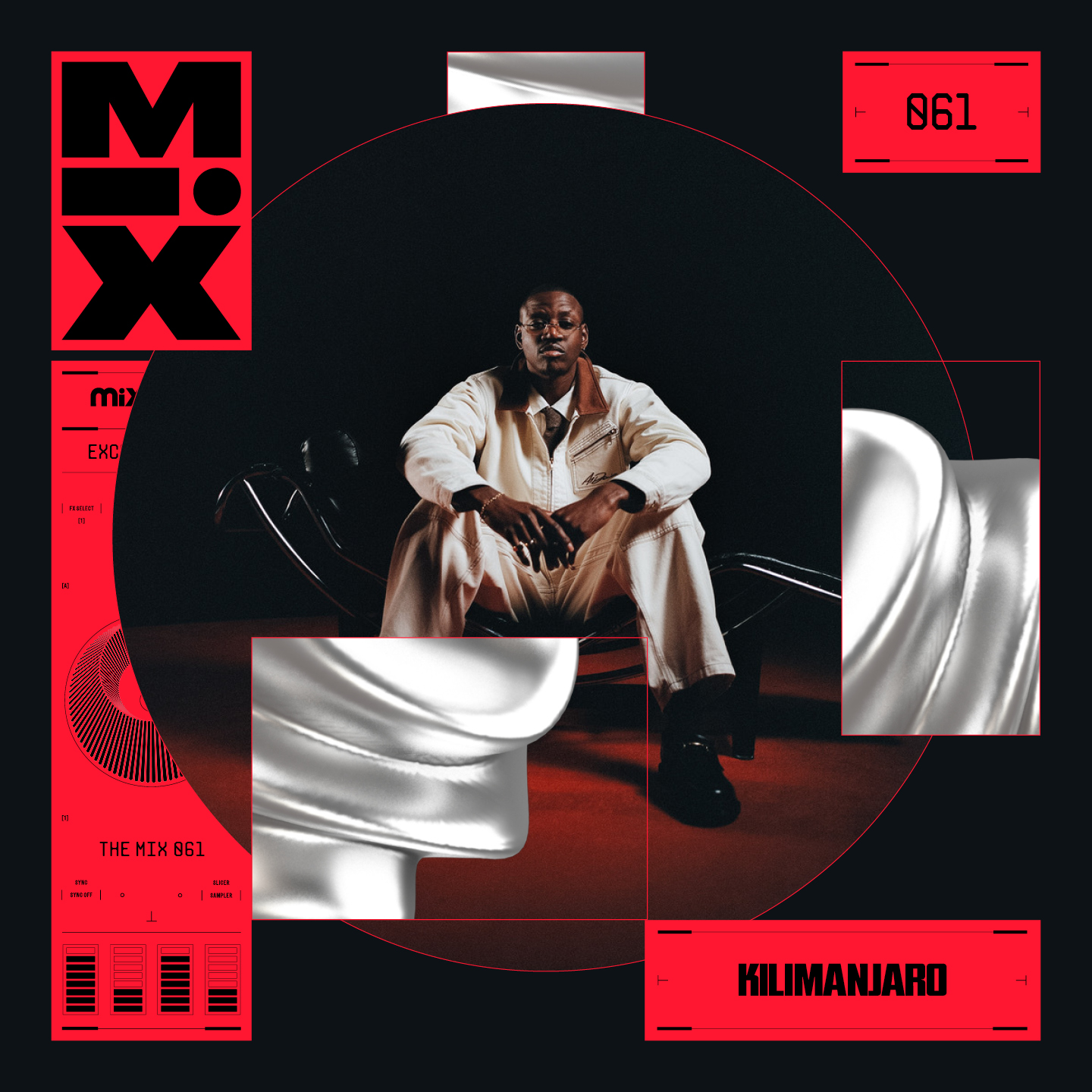
The Mix 061: KILIMANJARO
The Zambian-Scottish artist shares a high-energy mix and talks to Ben Jolley about his band drummer beginnings, accidentally becoming a DJ, viral success and how Bicep encouraged him to use his vocals
With a Coachella debut, Swedish House Mafia support slot and sold-out headline show at fabric under his belt already, it’s easy to see why KILIMANJARO has become a leading name in the global electronic music scene. But the Zambian-Scottish artist’s journey to the top of the dance league is no overnight success story.
In fact, his path to becoming a DJ, producer and vocalist was somewhat of a happy accident. At 12-years-old, he started playing the drums and formed a band, Our Future Glory, with his brother and a friend. “I feel like everyone picks up an instrument when they're young,” he recalls, adding that the group started writing, performing and releasing music from when he was 16. “That was when I fell in love with performing music – it was the gateway,” he says, adding that the band toured in Scotland, played some shows in London, and even Florida.
While his passion was ignited, putting in the hard graft as an up-and-coming band for the next 10 years proved tiring. “I was carrying loads of equipment around to different venues across the country in the evenings and then coming back to go to school or university or work – just for a half-an-hour set. It was tough.” Fortunately, things started to improve in 2016 when, having signed to London-based label Wall of Sound, the band played a show in Ibiza. “They also asked if any of us could DJ at an after party,” he recalls. “We were like ‘yeah!’ but obviously none of us could so I said ‘fuck it, I'll just learn’.”
This risk paid off, and he’s not looked back since. Upon returning from IMS, his DJing calendar quickly built up, resulting in him becoming a popular fixture of the club scene in Glasgow and Edinburgh. A move to London helped him find his footing on a national level, too, including collaborating with Irish producer Hammer. Releases on labels such as Higher Ground and Warehouse Project Records followed, before a Boiler Room set alongside Fred again.. in 2022 helped introduce him - and his energetic approach to being behind the decks - to a global stage.
This exposure - coupled with an exhilarating raft of unreleased material - proved the catalyst to signing a major label deal (with Capitol/Polydor). In March this year, his new EP, ‘Makalelo (Origins)’, landed as a sonic representation of both KILIMANJARO's thrilling club sets and what he calls “sounds of the Motherland”. Fusing Afro-centric rhythms and melodies with his own mesmerising vocals, the four-tracker harks back to his formative raving experiences while offering an exciting taste of what’s to come in the future.
Alongside sharing a mix - “it’s more high-energy than what people might expect, but features my favourite tracks at the moment including some originals and remixes and tracks from good friends” - KILIMANJARO discusses going viral, incorporating his heritage into his artistry, how Bicep’s approval led to his own voice featuring on songs, and why his latest EP is just the beginning.

How did you approach your first DJ set, and what was the impact of it?
I was running club nights at the time, and had been going out to proper clubs since I was 16, so the thought of ‘I could probably do this’ did cross my mind. I knew the ins and outs of it and, technically, using CDJs isn’t the most difficult thing to do. I learned on 800s, which are a far cry from what the 3000s are now…
I spent a few months learning and then went and played but didn't really think much of it. When I got back to Scotland, people were like ‘oh, you DJ’d in Ibiza, do you want to DJ at our bar?’. It went from one show a month to playing every week and then several times a week. Then I realised ‘ok cool, I can do this as work now’ and not have to worry about doing something in finance and focus on music instead.
How did you get into production?
I moved to Edinburgh and was interning at a studio there. That’s where I learned how to produce and build music. I put all the knowledge that I had from my band days into understanding how to structure songs. I also learned from what I was listening to in clubs and mixes and applied that to my sound and tried to figure out what that was and how it felt.
What is it about DJing that you enjoy so much?
Even when I was at uni, someone would DJ and I’d drum along, but there’s something magical about DJing that‘s different from drumming and performing live. I still love to perform live, and drumming is still a massive part of what I want to do going forward, introducing the live element into the KILIMANJARO project. There’s just a buzz you can get from DJing, though. I suppose I stumbled into it, but it felt like the right progression when it came to music and my career.
How did things progress from there?
I had built up enough of a name for myself in the Scottish scene and was playing clubs on a Wednesday and Thursday, and then doing more KILIMANJARO-related stuff on a Friday and Saturday. Then COVID happened and everywhere shut down, so I had a year in the wilderness where I wasn't able to play any music out. Because I was doing that as my full-time job before, I had no way of making an income. That was a really tough time, but it shaped me going into this next season. I ended up working for DPD as a delivery driver for a year, which was brutal, but I wrapped that in the summer of 2021 and had the opportunity to move to London.
Did you hope the move would help you to establish yourself in the dance scene?
Initially, I was only going to come down for the summer, but it was that summer where London really came back to life and I instantly fell in love with the city. I was born in London, but only visited as a kid and as an adolescent so hadn't really experienced it as an adult. A mate of mine, Rami Ali, showed me around and introduced me to loads of people. That really opened me back up to DJing again, because I was meeting people who were in the scene and really involved in stuff in London. But I was still doing all my shows back in Scotland too. So when Scotland opened back up, I was in London Monday to Wednesday, and then would travel to Scotland and DJ Thursday to Saturday, and then come back to London. I did that for about three months and played about 30 shows. Honestly, I would DJ anything - even if it was the opening of a crisp packet - just to get back out there and active again.
You’ve since become known for your high-energy, extroverted sets - how did your live background play into that?
Because there were only three of us on stage, it felt like we all had to provide the show and give people something to see. We were all dancing and moving, and I'd be standing up. It was fun.
It's a job, but it's a passion first and foremost, so it really stemmed from that. And the songs I’m playing, I like them, so I’m going to dance to them - performing live or in the studio. My individuality comes from expression and enjoyment, but that's not to say that a different DJ that doesn't want to dance couldn’t be having an even better time than I am.
It feels as though your artistry has a real sense of identity - why is that important to you?
There's almost an obligation to have a personality and an identity that can help others to draw theirs out. I think there's something really important in that, but I didn't stumble upon that overnight. An up-and-coming artist doesn’t need to have that immediately, but it definitely helps.
Because I've been in the game for a minute, I feel like I know who I am and, through that, I've been able to work out who I want to be as an artist and what I want to represent – musically, sonically and visually, but also what message I'm trying to portray. A lot of people are getting lost and trying to be something that they're not so that they can fit into a space or achieve something. But I think it's really important to figure out who you are and what you want to achieve, and just do that unapologetically.
What is your attitude towards genre?
Because I grew up listening to so much different music - everything from rap and hip hop to house, screamo and indie - it makes sense for me to create things in any shape or form. I just liked music where people were trying to say something, where there was passion, energy and excitement. I saw Bloc Party nine times when I was in my late teens – Matt Tong is still my favourite drummer and what Kele Okereke did in terms of songwriting was amazing; what they were singing about had a massive influence on my generation.
What Skepta does on the mic is super influential to me, too, and I’m trying to get there with my pen at the moment but it takes time. There’s definitely going to be more of me on the mic…
Read this next: Why Skepta and Jammer are embracing house music
Many of your songs feature your own vocals - how did that come about?
The first stuff I started making seriously, post-COVID, was with Hammer, who is a good friend of mine. He reached out and suggested we get in the studio but I wasn't really producing anything then, but I did have a lot of free time. We worked on a couple of records, and then with ‘Muleña’, the first single we put out in 2022, I had an idea for a vocal for it. We decided to put it down and then find someone to do something proper, but Hammer played it to the Bicep boys and they said we should keep that vocal on. If it's coming from Bicep, I thought ‘I must be doing something right’.
That was the initial thing because I genuinely didn’t have any desire or premeditated plan to be on my records. But, after doing the records with Third Son and Junior Simba where I featured vocally, that opened the door to express myself more. In 2023, I got to a place where I felt like I could start writing for myself and take the vocal part into the project and how I produce records – into building the three pillars that make up KILIMANJARO music. Because things are now getting a lot more serious, I’ll probably look at getting a vocal coach. It's always about developing and evolving and this is just the next phase.

You’re now signed to a major label - why did you choose that route and what has the experience been like?
I've seen so many people sign a whole array of deals - whether it's with majors or indies - and I was always going to proceed with caution. I loved that my A&R was interested in the project, as opposed to just a song. We signed in March 2024 and the music that I'm working on or has been signed off to come out… it's such a broad array of sounds, but within my space of KILIMANJARO music. That's because the label trusts me as an artist and what I'm trying to do – they see the vision, which was really important for me.
Before, I had done a couple of bits here and there, on Higher Ground and Warehouse Project, but it felt quite stop and start. People talk about the freedom that you get with indies but, for me, I really felt that I needed some longevity and a plan because what I'm trying to do is something that lasts, not a flash in the pan. I want to build something that will hopefully mean something to someone at some point. I needed stability, essentially, and the label definitely provided that.
You recently had a commercial hit with ‘No Bad Vibes’, your collaboration with Irish dance-pop artist Jazzy. How did that come about and is breaking into the mainstream a goal of yours?
When you make a song, you know it's good. But I didn't know people were going to take to it as well as they did. We spent a few hours on it and then sent it, but before we'd finished the session people were already feeding back. The next week, I was in a meeting with the label and they were all really excited about it. They moved everything about and she’s a super talented artist.
With what I'm trying to do artistically, I don't want to pigeonhole myself into any box that doesn't feel right for me - or a space where I feel that I can't do the things that I want to do. I'm happy to do more commercial-leaning stuff, because I know that I've got stuff that's not at all commercial. ‘No Bad Vibes’ came out and then I followed it up with ‘The Seeker’, which is totally different. I love that I’m allowed to do that and make what I want because it’s my project. It feels very free at the moment, which is important.
How does your latest EP [‘Makalelo (Origins)’] bring all these things together?
I wouldn’t quite call it a new beginning, but the purpose of it is to kickstart the project into a new phase. Everything that I’ve done before has built up to this place, but as the songs on this EP were written in 2023, it’s also the set up for what is coming next, and I’ve got loads planned this year. It’s different but in a similar space – I feel like I can reach out quite far. If you pigeonhole yourself it does get quite difficult.
How does your heritage play a role in your music?
My African-Zambian heritage is really important to me, even more so as I’ve got older. When I was at school, I felt like I needed to do everything I could to fit in – I’d think ‘how can I just be normal?’ I feel as though a lot of us lose our identity, or at least shy away from the things that make us us.
I’ve been making sure that my music and art have Afro-centric themes, rhythms, instrumentation and sampling all the way through it — that’s important for me. Later this year I’m going to be playing my first shows in Africa; I’ve still not played there so we’re building something special for towards the end of summer. I’m going to be working with some really cool artists, too, and playing some amazing countries. I’m excited to go there and learn; I want to be immersed in it.
Read this next: 17 women shaping African dance and electronic music
In 2021, you launched your own party, KILIMANJARO MUSIC, with the aim of championing Black, POC, female and other marginalised artists across the UK. Do you feel that representation in the industry has improved?
It has to have improved compared to what it was. Promoters and festivals are definitely more aware… but it could be a lot less crass and done more tastefully. Rather than just box-ticking, essentially – there was definitely a phase of that, but things are getting better every day. Bringing artists of colour and those from the LGBTQIA+ community forward is something that I’m always putting energy into.
To celebrate the release of your recent singles, you held pop-up parties in barber shops and record stores. Why did you choose these locations instead of clubs?
Especially mid-week, it's hard for people to get out to clubs. The clubbing landscape is quite tough at the moment, especially in the first quarter of the year. It's very, very difficult. I just wanted to give something back to fans where they could come out and it’s totally free. We gave away some merch, including scarfs and USBs. I wanted to throw a party and to say thank you for the support.
Meeting the people who support me is super important, because I've been a fan, a ticket buyer, a partygoer, a diehard. I want to create that space and always try, if I can, to take photos with people and have conversations with them after shows, because I remember how much it meant to me when people did that. The slight discomfort that I feel is heavily outweighed by the joy that it gives someone else.
I think we've gone through a time where everything's been super digital and very much online, whereas I remember when it was about being in person, street teams and connecting with fans – that’s something that I'm trying to bring back to the scene.
What have been the most surreal moments of your career so far?
The Fred again.. thing was funny because, at the time, we knew it was going to be a moment, but I'd worked with him for seven months so it felt normal. That became what it was and, following that, I’ve been so blessed to play some unbelievable shows. Supporting Swedish House Mafia in Mexico in front of tens of thousands of people was crazy; it was right by the Mexican national stadium where Maradonna scored the hand of God against England, which was so nuts.
Getting to travel loads and being able to do this how I've always dreamed of doing it… I think that’s what I'm most thankful of and blown away by. Especially thinking back to what I was doing in lockdown, thinking I would never have the chance to spin a record again, let alone be able to tour the world and have people singing my music back to me in the thousands. I'm just trying to be humble with it and take it a day at a time, but we're still aiming for greatness.
What’s coming up for the rest of the year? Is an album in the works yet?
I’m constantly writing. Some stuff is immediate and needs to be released now and pushed to the front of the queue. But I'm also writing stuff that I might not release for another year. This is the joy and comfortability that I've found working with Capitol. I know that, as long as I do my job and make the best music possible, I'm going to be able to do that across a long period of time, and in the way that I want to do it.
Tell us about the mix you have made for Mixmag.
It’s a huge honour to be asked to do a mix for Mixmag. I’ve been following Mixmag since before I even started DJing, so being asked to do this was an absolute treat. This mix is a little more high-energy than what people might typically expect from me, but it features a lot of my favourite tracks at the moment including some originals and remixes from myself as well as some tracks from some very good friends.
KILIMANJARO’s single ‘Good Shit’, featuring LEILAH, is out now, check it here
Ben Jolley is a freelance journalist, follow him on Twitter
Tracklist:
Sam Ruffillo & Kapote - La La Tune
Obskür - Can You Dig It
Jamie Jones & Green Velvet - Butterflies (KILIMANJARO Remix)
KILIMANJARO - Good Shit (feat. LEILAH)
ID - ID
Jamie Jones & AMÉMÉ - Pliva
Basement Jaxx - Flylife (salute Remix)
Capo Lee & bullet tooth - KEEP IT ROLLING (VIP MIX)
Tom Demac - Tiki Taka
SBTRKT - TURN YOUR HEART AROUND
Prospa - This Rhythm (feat. RAHH)
Tommy Gold - Do It Right
Timbee, Tommyboy - Beat on the Drum
Jazzy, KILIMANJARO - No Bad Vibes (With Jayda G)


