
 Features
From the archive: The party, the MDMA, the noise and the rage that made Goldie's 'Timeless'
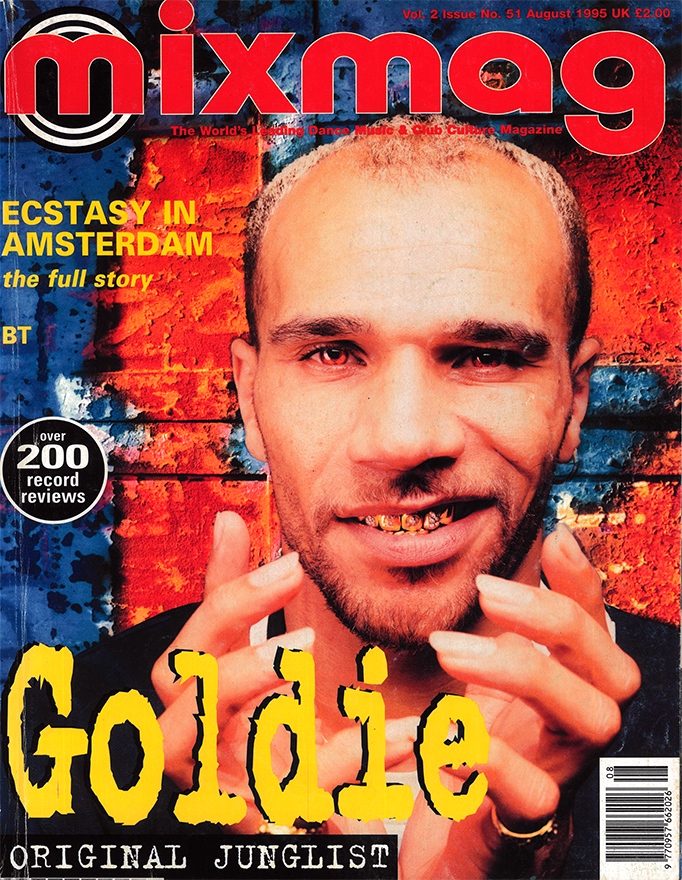
As one of dance music’s most crucial records, three decades on, Goldie’s debut album ‘Timeless’ is still living up to its name. Coincidentally, it’s also been 30 years since the August 1995 issue of Mixmag, in which the Metalheadz founder details the riotous scene that created the album, providing a unique snapshot of the foundational years of drum ’n’ bass
When Goldie first plugged into the rave in 1991, it was the beginning of plugging in a whole new dimension to the breakbeat dancescape. Goldie was by no means your average rave producer when he gave the world 'Terminator': darkcore's 1992 anthem of twisted noise, vapour trails and pitch-bending cyber warfare. His contemporaries were mainly kids, scarred by ecstasy's acne and living deep inside their Amigas and Apple Macs. Goldie was already a veteran of a decade's worth of hip hop lifestyle, an artist with a widescreen vision.
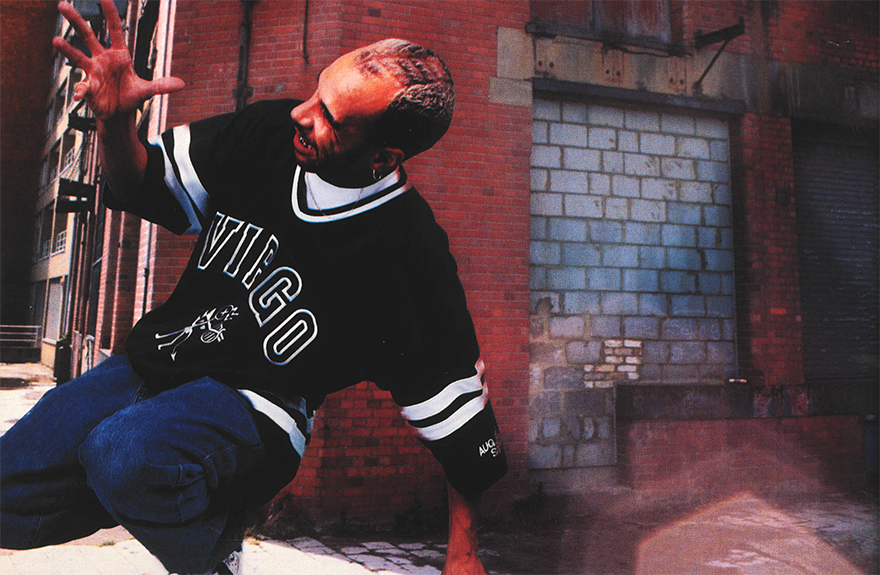
Right now we're marking time in a London photo studio, taking pictures. Goldie even spins on his head for a shot, calling up his breakdancing past. People are hanging around, smoking cigarettes, and the curling smoke shoots him back in time. Back to when he used to party with girls like Kemistry and Storm. In 1991, when they used to check Fabio and Grooverider play at legendary London hardcore night Rage. Before the girls were DJs and before Goldie made records.
"You know when you can almost smell that first cigarette or that old place?" he asks. "I'm remembering when I was first seeing Kemi and we got back one night from Rage, and we were out of it. They wanted to be DJs so badly they dragged out the fucking Binatone system and Kemi's deck and tried to mix on these two fucking stack systems. And it was the best thing, in this room, out of our nuts, with the lights off and trying to mix on these two turntables going at two different speeds. And I smell that sometimes, I smell that room when we first began with these two girls who really wanted to be DJs and this geezer who really wanted to make music." Five years on from Rage and Kemistry and Storm are DJs now. They're playing at London's Speed club every week and getting work all over the country. It won't be long before they're making records, cutting deals and DJing outside the UK. They're getting close. But Goldie's even closer. Goldie was the first breakbeat producer to get a major label deal since Shades Of Rhythm and Unique 3, when he signed to London/FFRR Records last year for £200,000. He played Glastonbury this Summer alongside Pulp, Oasis and Orbital. A Guy Called Gerald reckons Goldie's music is so important and so beautiful that he doesn't need to wait for a new Derrick May record. He's got Goldie instead.
Goldie's just about to release his debut LP 'Timeless'. Over 90 minutes long, listening to 'Timeless' is like taking an adventure. If the limits of music are the limits of society, then 'Timeless' is going to create new worlds. It's a record that travels from darkness to light across electronic oceans, across streetsoul, ambience and jazz. It's a record that is interested in sound. A chord will play and you won't know if it's a harp, a choir of angels or a machine. And the tracks Goldie builds from these sounds are just as radical. Like the best DJ sets, they seem to liquidise space and rhythm into strong currents you can just get lost in.
But there's more to 'Timeless' than the white heat of futuristic music. There are words and feelings that feedback into the kind of music that's always been popular. The kind of songs people like, even if they don't understand the scene that spawned them.
"Timeless' is just breakbeat," explains Goldie, "cutting-edge breakbeat from a layman's point of view, and it's also personal. It's kind of like the last ten years, ten years of development. It freaks me out, man. It's just that Grooverider, Fabio, Randall, Doc Scott, they've all been there before me. I went to see Groove at (London dance station) Kiss when he was doing his show, and he put me on the spot, asking me about Glastonbury. It really freaked me out thinking that we've gone all this way. Did we really want to go this far?
Well, he should know. Goldie is the first artist to load breakbeat with the classical singing and songwriting values of Massive Attack, Björk or Soul II Soul. Tracks like 'Angel' and 'Adrift', sung by the luscious-voiced Diane Charlemagne, are songs, ballads mutated by technology but anchored with infectious harmonies and delicate vocals. At one level, he insists 'Timeless' is just for Doc Scott, Fabio, Grooverider, Kemistry and DJ Ron. It's something they can listen to at home because their sets and tunes inspired him so much. But he also talks about the record as if it was an advanced weapons system to destroy the enemies of breakbeat.
Read this next: Goldie hints at retirement: “I’m going to hang my gloves up and be 60”
"I have a job to do and my job is to make breakbeat more acceptable," explains Goldie. "Timeless' is a wolf in sheep's clothing. You can listen to it anywhere in the fucking world and you'll hear it right. I took some [drum n' bass] tunes out to Europe and the US and I listened to them on face value. Some of them don't stand up. It can be mocked by others. I'm not about to have this music mocked anymore."
It's weird to hear how driven he is because it's a miracle he got involved in the rave at all. Like The Orb's Alex Patterson, he was old before the scene even started. Before rave, Goldie had been and seen so much that he should've been burned out by then. He'd been a break-dancer, a jeweller, a B-boy, a football hooligan, a graffiti artist. He'd moved from his native Walsall and chased hip hop culture across the world, living in London, New York and Miami. He'd been involved in some heavy scenes. And it wasn't until he came back in '91 that he reached the rave.
And like a lot of people who started then, he was told that because he hadn't been to Shoom or Sunrise or Land Of Oz, he didn't understand. Because the records that rocked his world were made by Carl Craig and Doc Scott, not Paul Oakenfold and Andrew Weatherall. And while the press and record industry believed the myths of 1989, he was living in a different reality. And people were slating it.
"It was that whole misconception of what we were about," he winces. "Trying to pigeonhole us into being music for crackheads. You know, trash breakbeat, let's all go progressive. They were trying to predict to the youth culture what was going on, and it all backfired."

Instead, Goldie has his own vision of youth culture, history and rave. Perhaps if he was an indie kid, he'd have been content with New Order or The Cure when he was growing up. But US hip hop and B-boy culture shaped his understanding of England.
"We grew up in an era where youth culture was something which was imported from the US," he recalls, "and everything from the music to Adidas sneakers to whatever was imported. We had no identity from here. If we didn't have America to look at, we'd have been like every other fucking Eastern Bloc country. It's the youth culture that changed us. And prior to rave, barring punk, this is the only thing that was original UK shit. People should have been writing the stories about what was really going down. They should have spent more time looking at British breakbeat. I guess if they had written them down, it wouldn't be working for us now."
Because the war is almost over now. Goldie, Gerald, Roni Size, Alex Reece, Rupert Parkes, LTJ Bukem, DJ Crystl, 4 Hero, DJ Rap, Dillinja, Danny Breakz and Ray Keith are all picking up media coverage, major label remixes and deals. Rave has been reinvented as jungle, drum ‘n' bass and ambient jungle. There was even a fine breakbeat compilation released by React called 'Artcore'. Orbital, Underworld and Armand Van Helden have all tried and failed to produce drum ‘n’ bass tracks. And freestyle artists like Wagon Christ, Boymerang and Reload, as Kaos & Julia Set, have found enough space in jungle to flex their indie/art muscles. Even happy hardcore, the most loathed of all rave styles, is now replayed, thanks to Liquid and Baby D, as sweet chart pop.
"It's just weird because it's happened so fast," reckons Goldie, "and now everybody's doing alright. The first wave of media bullshit people have left, and we're all just doing things now and contributing to it. People who have been in this game for a long time are beginning to go out and get what's theirs. I just feel proud that it's a British movement and there's a lot of people involved in it."
Read this next: Goldie creates mural in tribute to Randall on first anniversary of his death
I wanted to change Goldie's words in this paragraph. I didn't think I should let him say 'British movement’. It sounds sick. But then the rave is something the fascists could never accept. It couldn't have existed without a cross-racial and cross-sexual mix of ideas, technology, sounds and chemicals. Everyone from old punks to old queens to old B-boys has claimed some part of this culture. It's not because any of them are right or wrong, it's just that raving, in all its forms, is now as English as fish and chips or football. Everyone in England from fashion victims to Goa hippies, has taken a piece of it. So it is a British movement. And when Goldie talks about the ravers themselves, thanking them for their support, you know he's talking about Britain.
"Those punters with their YTS [Youth Training Scheme] jobs and whatever," he says, "they went out and bought all this fucking music. They're the people I have to say thank you to. They supported us and said, 'Look, we love this breakbeat stuff, we're hardcore mate, we're gonna tread all night in a field, and not wear a T-shirt and freeze to death and fucking die from hypothermia. But we love the music and want to listen to it and support all the DJs and do all of that.'"
You might think we're overdoing the patriotism here. But Goldie isn't just another underground dance producer. He is a true modern original. And if 'Timeless' is successful, his vision of Britain is going to be mapped against everyone else's. And you have to ask how many veterans of nights in fields and 5:AM comedowns can see their Britain, their culture and their history in anyone else's music.
It’s interesting to wonder why youth culture is so important for Goldie. Why he didn't just pass through it but got deeper and deeper. The son of an English mother and an absent Jamaican father, he grew up in care and with a series of foster parents. You realise how cold his childhood must've been when he discusses the love, support and strength he found elsewhere. Like at Rage, where he passed through the growing-up thing of watching the DJ play records to watching the DJ play his records. Watching Grooverider.
"The thing that cracks me up is Groove mate, he's the straightest geezer," laughs Goldie. "He doesn't do any fucking drugs mate, and he's been like playing for so many years with all these people off their fucking nuts. He's got a genuine love for the people and a love of the music. I was one of those kids fucking E'd off my nut, week in week out, and that's what did it for me. Having people you can look up to. When you get into that whole care system, you don't have anyone to fucking trust or rely on. These people within the music, we have an understanding. There is an internal affairs thing going on."
Read this next: Goldie: “People never give props to drum 'n' bass for what it's done for electronic music"
A few years ago Manix, Goldie, and the Reinforced crew produced an EP called just that: 'Internal Affairs'. There's one track on it, 'Hands To Heaven', that's pure Goldie. Listen to this and you'll be listening to the seed of 'Timeless'. All of his sounds are here. The contrasts between warm, human vocals and metallic Detroit strings and harsh artificial noises. And they appear again and again on 'Timeless', huge black holes where harps, dolphins and angelic vocals are sucked into spinning chasms of dark-core sound.
"I'm just a dark brother I guess," smiles Goldie, "| guess that's me. I had a dark background and a dark upbringing and I come out a bit dark really. It's a shame really. I guess a lot of people said I fucked up growing up.”
Goldie's career reads like a shift from darkness into light. The first releases, his Rufige Cru EPs and 'Terminator' track, interfaced breakbeat with the distortion and industrial noise of Belgian hardcore. 1993's 'Angel' started to reshape fucked-up breakbeat with real vocals, ambient textures and pure trebles. 'Timeless' brings all the pieces back together. Like on 'Sea Of Tears' where you can hear Goldie's split-second tempo changes, effects shooting off like flares in darkness and the hi-tech breakbeats covering an elastic expanse of synthetic sound. But 'Sea Of Tears' also has waves breaking over sunset guitars, live, harmonious jazz bass, whales singing to an ambient ocean and a girl whispering and sobbing into your ear.
"It's a sad track man," says Goldie, "it's not there to be pretty, it might sound musical or whatever but it has its dark corners. It's just a mood isn't it? My upbringing was a bit fucking sad, wasn't it? Everybody has corners to go to. 'Sea Of Tears' is mine."
So Goldie mapped his own feelings into the music as well. It's not just a missile aimed at rave's detractors, instead like the rave and party scene itself, the music is a place of escape, a fully-formed reality into which we can hide or live.
"[Junglist DJ] Peshay made a point to me last night. He said from the time you put the needle on it you're in my world. Then when you take the needle off you're back to reality. Fucking hell, he said, you're in Goldie's land. You're in my land and I guess as an artist I've got a big back garden to run rampant in."
Read this next: Flying the junglist flag: Nia Archives is leading jungle's new era
You only have to listen to his breakbeats. Sometimes the break covers the entire frequency of a track, from the deepest bass to the highest treble. And the break moves and lives, expands, contracts, explodes, somersaults. It seems to talk to you and travel across feelings, ideas and emotions. Afrika Bambaata talked about looking for the perfect beat, ten years on and Goldie talks about making the perfect beat.
"You can take things apart so much," grins Goldie, "before we used to drop a glass and it would drop into four pieces. Now when we drop it there's a thousand pieces and because of my production level we can put all those pieces back together again."
About a year ago I watched Goldie and his co-producer Rob Playford working in Rob's Stevenage studio. They spent hours working on just a few seconds of music. They'd take a snare, reverse it, flip it upside down, make it go faster, into echo, harmony, everywhere. Eventually it sounded nothing like the tiny little noise they'd started with.
"We have to take it forwards and take the drum n' bass and push it and push it and push it. I remember when we were saying that it can't be pushed anymore. It's been pushed tenfold since then," he growls. "We beat the music up, everything got taken hostage, ripped up, taken to shreds, taken apart. That's what breakbeat did for a lot of things. And it's a lot better because we're playing with it now. The war is over and we're moving on."
So what does ‘Timeless' sound like? It sounds like a record that you can't ignore because it's supposed to rewrite a history that was squashed. It's an attack, a confession, a dance, a chill-out and a place to hide. It's also 'Timeless' has a record that refuses to leave the rave. dirty breakbeats that are still covered in mud, endless harmonic drones that seem designed to make your E last longer and all the soft, fractured sounds of the come-down. And make no mistake about it, this is the sonic equivalent of hip hop's battle rhymes: a weapon to shake the world. You've only got to hear Goldie discuss MoWax and the title James Lavelle and Carl Craig gave to one of their remixes to get the picture.
"It's like trip hop,” sneers Goldie, "slow down some hardcore and I'll show you trip hop. What does it say on that record sleeve? 'Ravers suck our sound and get fucked'. Where did they get their samples from? They just looped them from us so why are they slagging our music when they're taking from us and we're doing even more with it than them?"
And right now this desire to make everyone accept his version of history is what really drives Goldie. Because 'Timeless' is a record that couldn't have been made if it wasn't for the party, the MDMA, the noise and the rage. 'Timeless' tells you that you can't ignore or erase this history because to Goldie, and to so many others, it holds their lives, dreams and feelings. So Goldie's trying to make his sound so awesome that everyone has to suck on it. Everyone from the authors of the Criminal Justice Act to all the DJs, writers and producers who feared this music and hoped it would die. And if ‘Timeless' is as successful as it deserves to be, then a lot of people are going to have to suck. And swallow.
This feature was taken from the August 1995 issue of Mixmag


